Servpro vs Local Contractors for Water Damage
comparison · September 15, 2026 · Editorial Team
Table of Contents
- Servpro vs Local Contractors: A Quick Comparison
- Water Damage Restoration Cost Per Square Foot: What Drives the Price
- IICRC Certification Importance: Why Credentials Matter
- The Insurance Claim Process for Water Damage: Who Helps and Who Hinders
- Equipment Verification: Does Your Contractor Have the Right Tools?
- The Hand-Off Problem: When Mitigation and Reconstruction Don't Talk
- Contractual Red Flags: What to Watch Before You Sign
- Making the Right Choice for Your Water Damage Emergency
- Frequently Asked Questions
Last Updated: September 15, 2026
Servpro vs Local Contractors: A Quick Comparison
When water damage strikes, homeowners face a decision that shapes both their repair costs and their stress levels: hire a national franchise like Servpro or work with a local contractor. This guide from SmithFamilyPaintingandProjects breaks down the real differences so you can choose with confidence.
The stakes are higher than most people realize. Water damage restoration is a race against time, and the contractor you choose determines how quickly mitigation begins, how thoroughly structural drying is completed, and whether your insurance claim moves smoothly or stalls.
Here's the core tension: national franchises offer scale, standardized processes, and brand recognition. Local contractors offer accountability, flexibility, and often better pricing. Neither is universally better, but one is usually the right fit for your specific situation.
| Factor | Servpro | Local Contractors |
|---|---|---|
| Availability | 24/7 national network | Varies; many offer emergency service |
| Pricing | Higher overhead, standardized rates | Often more flexible, negotiable |
| Accountability | Corporate + franchise layer | Direct owner access |
| Insurance support | Dedicated claim teams | Varies widely |
| Local knowledge | Limited to franchise territory | Deep community ties |
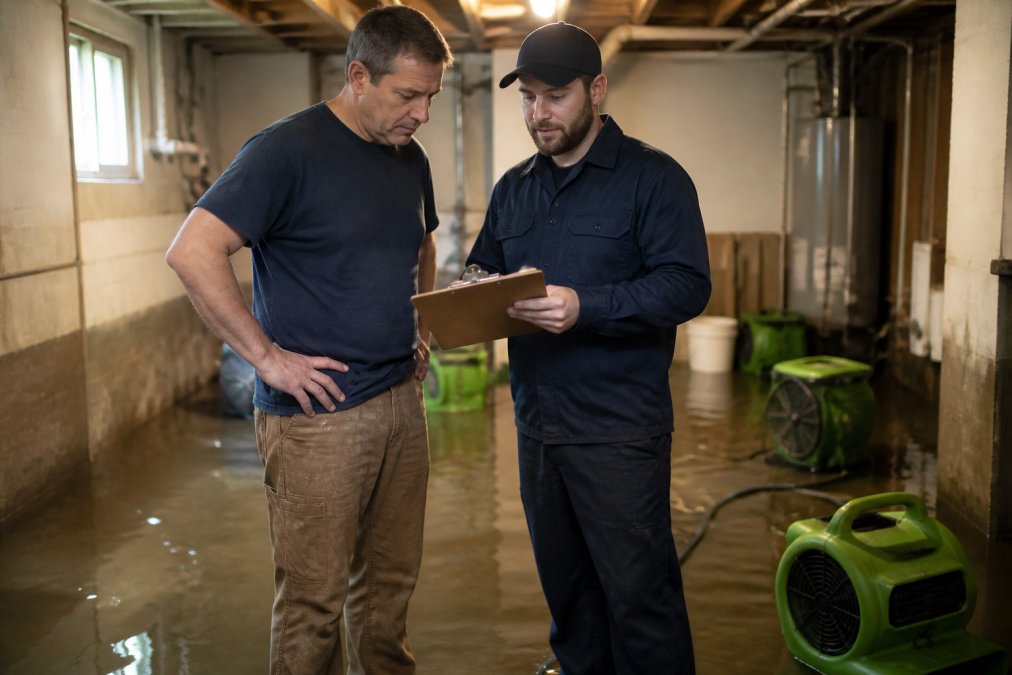 A homeowner and a contractor in work clothes reviewing a clipboard with damage assessment notes in a flooded basement, water visible on the floor, professional restoration equipment in the background
Water Damage Restoration Cost Per Square Foot: What Drives the Price
Water damage restoration cost per square foot varies based on several factors, and understanding them helps you evaluate estimates fairly.
The biggest cost drivers include:
- Category of water (clean, gray, or black water requires different handling)
- Extent of saturation (surface moisture vs. deep structural penetration)
- Materials affected (drywall, hardwood, carpet, and insulation all dry differently)
- Accessibility (crawl spaces and finished basements cost more to dry)
- Mitigation vs. reconstruction (drying and extraction cost less than rebuilding)
National franchises typically carry higher overhead: corporate fees, franchise royalties, and standardized equipment packages. Local contractors often operate leaner, which can translate to more competitive pricing, especially for non-insurance projects.
What most guides miss is that the cheapest estimate isn't always the least expensive outcome. Incomplete drying leads to mold remediation later, which costs significantly more than doing the job right the first time.
IICRC Certification Importance: Why Credentials Matter
IICRC certification importance comes down to one thing: verified competency in water damage restoration.
The Institute of Inspection Cleaning and Restoration Certification (IICRC) is the recognized standards body for the restoration industry. Technicians who hold IICRC credentials have completed training in water extraction, structural drying, moisture mapping, and industry standards.
Why this matters:
- Certified technicians follow established drying protocols
- They document moisture readings properly for insurance claims
- They know when to stop drying (avoiding secondary damage)
Not every contractor holds this certification. Ask directly, and verify. A contractor who can't produce credentials may still do good work, but you're accepting more risk.
The Insurance Claim Process for Water Damage: Who Helps and Who Hinders
The insurance claim process for water damage runs smoother when your contractor understands how adjusters think, but the real differentiator isn't whether a company has a "claims department." It's whether the documentation they produce matches the line items your adjuster is authorized to pay.
Here's the mechanism most homeowners never see. When you file a water damage claim, your adjuster works from a scope of loss built in estimating software such as Xactimate, the platform most carriers and independent adjusters use to price restoration work. Line items are pre-coded: a certain number of air movers per affected room, a set number of drying days, specific charges for antimicrobial application, cavity drying, and content manipulation. If your contractor's documentation doesn't map to those codes, the adjuster either denies the line or pays a reduced amount, and you cover the difference.
That's why documentation quality, not brand name, drives your payout. The three documents that matter most:
- Moisture mapping records, daily readings from calibrated meters showing the drying curve from wet to dry standard. Without a documented curve, an adjuster can argue drying was unnecessary or incomplete.
- Photo evidence with timestamps, before, during, and after, tied to specific rooms and materials.
- Itemized estimates in carrier-recognized format, a lump-sum invoice forces the adjuster to guess, and adjusters don't pay guesses.
How national franchises and local contractors actually differ here
National franchises like Servpro typically have in-house claim coordinators who speak the adjuster's language, submit documentation in Xactimate format by default, and can escalate to a regional claims manager when a file stalls. That standardization is a genuine advantage on large or contested claims.
Local contractors split into two groups. Some are excellent claim advocates, often because the owner has handled hundreds of local claims and knows which adjusters in the area want what. Others hand the paperwork to you and let you negotiate alone. The pattern is consistent: the contractor's claim experience matters far more than the size of the company.
Questions that reveal whether a contractor will advocate for you
Ask these before you sign anything:
- "Do you submit estimates in Xactimate or a comparable carrier-recognized format?" If the answer is "we just send an invoice," expect friction.
- "Will you communicate directly with my adjuster, or do I relay everything?" Direct communication shortens timelines and reduces miscommunication.
- "What happens if the adjuster's scope is lower than yours?" A good answer describes a documented supplement process, additional moisture readings, photos, and a revised estimate, not a shrug.
- "Do you charge for the initial assessment if the claim is denied?" Get this in writing.
The supplement process, where claims are won or lost
A supplement is a revised estimate submitted after the initial scope, usually because hidden damage was found once walls were opened or because drying took longer than the original estimate assumed (Understanding the insurance claims payment process). Contractors who routinely file supplements recover more for homeowners; contractors who don't leave money on the table.
If your contractor finds wet insulation behind drywall that wasn't in the original scope, that's a supplement, and it should be documented with photos and meter readings the same day, not weeks later.
Sample homeowner claim documentation checklist
Equipment Verification: Does Your Contractor Have the Right Tools?
Equipment verification separates professionals from pretenders, but "ask to see the equipment" isn't a real test. A homeowner can't tell an industrial dehumidifier from a consumer unit at a glance. Here's a checklist you can actually run.
The minimum equipment set for structural drying
Proper water damage mitigation requires:
How to verify, five checks that take ten minutes
What the equipment tells you about the company
The Hand-Off Problem: When Mitigation and Reconstruction Don't Talk
Contractual Red Flags: What to Watch Before You Sign
Making the Right Choice for Your Water Damage Emergency
Frequently Asked Questions
Is it better to use a national restoration company or a local contractor?
It depends on your priorities. National franchises offer 24/7 availability and established insurance relationships. Local contractors often provide more transparent pricing, direct owner accountability, and community reputation. For non-insurance repairs, local contractors may be more cost-effective. For complex claims, national brands may have more adjuster experience. Ask both for references and compare their water damage restoration cost per square foot.
Does homeowners insurance cover the cost of Servpro?
Most standard homeowners insurance policies cover sudden water damage, regardless of whether you use a national franchise or a local contractor. Your policy pays for covered losses, not a specific company. However, some insurers have preferred vendor programs. You can still choose your own restoration professional in most states. Review your policy and ask your adjuster about any network requirements before authorizing work.
Do local contractors have the same equipment as national restoration firms?
Many IICRC-certified local contractors own truck-mounted water extractors, commercial dehumidifiers, and moisture mapping tools. National franchises may have larger inventories for catastrophic losses. The key is equipment verification: ask what they bring on-site for your specific job. A local contractor handling a basement flood likely has everything needed. For multi-room damage, confirm they can scale equipment to your square footage.
How quickly can a local contractor respond to water damage compared to a franchise?
Response time depends on the individual business, not the brand. A local contractor based in your community may arrive faster than a franchise dispatching from a regional hub. Ask for a guaranteed response window in writing. Both should offer 24/7 availability for emergencies. In rural areas, local contractors often have a geographic advantage over national chains.
What should I look for in a licensed and insured water damage contractor?
Verify their state contractor license, general liability insurance, and workers compensation coverage. Ask for IICRC certification in water damage restoration. Request a written scope of work with labor rates and square footage pricing. Confirm they handle insurance claim documentation. Read the service agreement for exclusions. Check BBB ratings and ask for local references you can call.
Frequently asked questions
Is it better to use a national restoration company or a local contractor?
It depends on your priorities. National franchises offer 24/7 availability and established insurance relationships. Local contractors often provide more transparent pricing, direct owner accountability, and community reputation. For non-insurance repairs, local contractors may be more cost-effective. For complex claims, national brands may have more adjuster experience. Ask both for references and compare their water damage restoration cost per square foot.
Does homeowners insurance cover the cost of Servpro?
Most standard homeowners insurance policies cover sudden water damage, regardless of whether you use a national franchise or a local contractor. Your policy pays for covered losses, not a specific company. However, some insurers have preferred vendor programs. You can still choose your own restoration professional in most states. Review your policy and ask your adjuster about any network requirements before authorizing work.
Do local contractors have the same equipment as national restoration firms?
Many IICRC-certified local contractors own truck-mounted water extractors, commercial dehumidifiers, and moisture mapping tools. National franchises may have larger inventories for catastrophic losses. The key is equipment verification: ask what they bring on-site for your specific job. A local contractor handling a basement flood likely has everything needed. For multi-room damage, confirm they can scale equipment to your square footage.
How quickly can a local contractor respond to water damage compared to a franchise?
Response time depends on the individual business, not the brand. A local contractor based in your community may arrive faster than a franchise dispatching from a regional hub. Ask for a guaranteed response window in writing. Both should offer 24/7 availability for emergencies. In rural areas, local contractors often have a geographic advantage over national chains.
What should I look for in a licensed and insured water damage contractor?
Verify their state contractor license, general liability insurance, and workers compensation coverage. Ask for IICRC certification in water damage restoration. Request a written scope of work with labor rates and square footage pricing. Confirm they handle insurance claim documentation. Read the service agreement for exclusions. Check BBB ratings and ask for local references you can call.