How to Find Reliable Home Repair Services in Danville
listicle · September 9, 2026 · Editorial Team
Table of Contents
- Why Finding Reliable Home Repair Services in Danville Is Hard
- Comparing Your Options for Home Repair Services
- SmithFamilyPaintingandProjects: A Local Class A Contractor
- Online Directories and Review Platforms for Danville
- The Benefits of Hiring a Class A Contractor
- Questions to Ask Home Repair Contractors Before Hiring
- How to Verify Contractor Insurance and Credentials
- Your Vetting and Safety Checklist for Home Repairs
- Frequently Asked Questions
Last Updated: September 9, 2026
Why Finding Reliable Home Repair Services in Danville Is Hard
The search for finding reliable home repair services Danville often starts with a directory, not a recommendation. Few listings tell you whether the person showing up at your door will finish the job, protect your property, or communicate honestly when a project hits a snag.
Homeowners in Southside Virginia face a specific challenge: the difference between a handyman and a contractor who can manage a full renovation is massive. Hiring the wrong person for a structural repair or kitchen remodel can turn a manageable project into a costly ordeal. Finding reliable help requires a different approach than picking the first result.
SmithFamilyPaintingandProjects guides homeowners through this process. A reliable home repair provider is a licensed, insured professional who delivers consistent quality and communicates clearly from the first estimate to the final walkthrough. This guide explains how to separate those professionals from the rest and what credentials matter.
Comparing Your Options for Home Repair Services
Danville homeowners typically choose between a few distinct paths when a repair or renovation project comes up.
| Option | Best For | Key Considerations |
|---|---|---|
| Class A Contractor | Major renovations, structural work, full remodels | Higher accountability, licensed and insured, manages whole project |
| Handyman Service | Small repairs, fixture replacement, minor carpentry | Limited scope, may not handle structural or permit-required work |
| Online Directory Match | Comparing multiple quotes quickly | Quality varies significantly, vetting is on you |
| National Franchise | Standardized service with brand backing | May lack local flexibility, availability varies |
A Class A contractor in Virginia holds the highest license classification issued by the state, allowing them to handle residential and commercial projects of any size (dpor.virginia.gov). This distinction matters for finding reliable home repair services Danville homeowners can trust with complex jobs. Handyman services fill a real need for small tasks, but they typically cannot pull permits or take on structural work.
The decision starts with project scope. A leaking faucet does not require a general contractor; a load-bearing wall removal absolutely does.
SmithFamilyPaintingandProjects: A Local Class A Contractor
When the project involves a major renovation, water or fire damage, or work that requires permits, the local Class A contractor becomes the strongest option. SmithFamilyPaintingandProjects operates as a licensed, bonded, and insured Class A HIC Virginia contractor serving Danville, Chatham, and Pittsylvania County. This classification is a state-issued credential, not a marketing label.
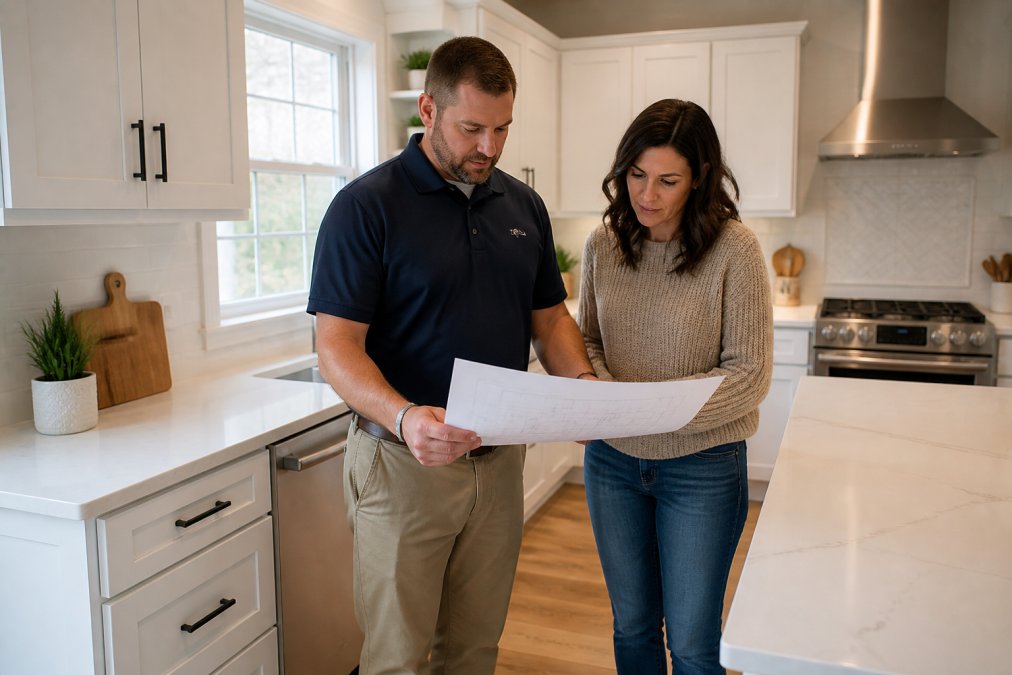 A professional contractor in a branded uniform reviewing project plans with a homeowner inside a bright, recently renovated kitchen with new cabinetry and countertops
The family-owned business brings more than credentials. Voted #1 on NextDoor for four consecutive years, 2022 through 2025, the company has built its reputation through neighbor-to-neighbor referrals. An A+ rating with the Better Business Bureau and the Angi Super Service award for 2025 reinforce what local homeowners already know.
What distinguishes this provider is the combination of skilled workmanship and honest communication, with comprehensive project support from start to finish. For homeowners burned by contractors who vanish mid-project, this accountability changes the risk calculation entirely.
Online Directories and Review Platforms for Danville
Online directories like Angi, HomeAdvisor, and Thumbtack are often the first stop for homeowners searching for finding reliable home repair services Danville. They offer convenience and a veneer of credibility through star ratings, but treating them as a definitive quality filter is a mistake. They are lead-generation engines first.
How Directory Lead Generation Works
When you submit a request on Angi or HomeAdvisor, your project details are packaged and sold to contractors who pay for leads. The contractors who contact you are not necessarily the best match for your job, they are the ones who paid for your contact information. This does not automatically disqualify them, but it shifts the burden of vetting onto you.
The Review Volume Problem in Smaller Markets
In a market like Danville, review volume on national platforms is often thin. A business with 15 reviews on Angi might be a brand-new operation buying leads, while a well-established local firm might have only a few reviews because their work comes from referrals. Comparing them on review count alone is misleading.
A Practical Cross-Referencing Strategy
Instead of relying on a single platform's score, use directories as a starting point for a cross-referencing exercise:
- Identify candidates from at least two different sources, one national directory and one local source like NextDoor or the Better Business Bureau.
- Look for overlap. If the same company name appears on multiple platforms with consistent ratings, that is a positive signal. Inconsistency is a red flag.
- Read the negative reviews first. A single scathing review about an uncompleted job or poor communication is more informative than ten vague five-star reviews. Look for how the business responded. A professional, non-defensive reply to criticism indicates accountability.
- Check the dates. A business with a 4.8-star rating from 2021 but no recent reviews may have changed ownership or stopped operating. Current activity matters.
- Verify the license. Before you even call, look up the company name on the Virginia Department of Professional and Occupational Regulation (DPOR) website. This step filters out unlicensed operators before you waste time on a phone call.
The Local Signal: NextDoor and Community Groups
National directories lack the granular, neighborhood-level signal that local platforms provide. NextDoor is powerful in Danville because recommendations come from your actual neighbors, not anonymous users, and you can message them directly for details. Sustained local recognition like SmithFamilyPaintingandProjects' four consecutive #1 NextDoor votes carries more weight than a paid directory listing.
What to Do With Directory Information
Once you have a shortlist from directories, your job is not to pick the highest-rated option but to use that list to initiate a vetting conversation. Call each candidate and ask the questions outlined in the 'Questions to Ask' section.
The Benefits of Hiring a Class A Contractor
The term 'Class A' is often misunderstood. In Virginia, it is not a marketing badge but a legal classification from DPOR granting a contractor the authority to handle projects of any size and value, the highest tier of contractor licensing in the state. For finding reliable home repair services in Danville, the benefits go far beyond the legal definition.
Financial Protection and Bonding
A Class A contractor is required to post a bond with the state, a financial guarantee protecting you if the contractor fails to complete the work or violates regulations. If a contractor abandons a project or performs substandard work, you have a formal channel to file a claim against that bond, a layer of protection you do not have with an unlicensed operator.
Insurance and Liability: The Real Cost of 'Cheap'
Perhaps the most underappreciated benefit is the insurance requirement. A Class A contractor must carry both general liability insurance and workers' compensation (dpor.virginia.gov). If a worker falls off a ladder on your property and the contractor lacks workers' compensation, the medical bills could become your responsibility. The difference between hiring a licensed, insured professional and an uninsured operator is the difference between a manageable project and a potential financial catastrophe.
Scope of Work: What a Class A Contractor Can Do That Others Cannot
A handyman service is valuable for small tasks like replacing a faucet or patching drywall, but their legal scope is limited. In Virginia, a handyman cannot pull a permit for structural work, electrical rewiring, or plumbing modifications; a Class A contractor can (dpor.virginia.gov). If a project requires a permit, the work will be inspected by a local building official, an independent check on quality and safety.
The Cost Reality: Comparing Apples to Oranges
The price difference between a Class A contractor and a handyman can be significant. But the Class A quote includes overhead for insurance, bonding, permit fees, and inspection scheduling; the handyman's likely includes none. The 'savings' evaporate when you factor in the risk; the cheapest quote is often the most expensive in the long run.
Accountability and Recourse
Finally, a Class A contractor operates under DPOR oversight. If you have an unresolved dispute, you can file a formal complaint with the state, creating a powerful incentive for the contractor to resolve issues professionally. An unlicensed operator has no such incentive.
Questions to Ask Home Repair Contractors Before Hiring
A short conversation can reveal more about a contractor than hours of online research. Questions to ask home repair contractors should focus on accountability, process, and communication.
Start with the basics: Are you licensed in Virginia, and what is your license number? Can you provide proof of insurance and workers' compensation? How long have you been operating in this area? A contractor who hesitates or deflects on licensing and insurance is a red flag regardless of their portfolio.
Move to process questions that reveal how they handle challenges. Ask how they handle change orders when unexpected issues arise, who will be on site daily, and how they communicate progress. Ask for references from similar projects, then call them.
How to Verify Contractor Insurance and Credentials
Verification is a paperwork exercise that takes minutes and prevents months of headaches. How to verify contractor insurance starts with asking for a certificate of insurance directly from the contractor's provider, not a photocopy. The certificate should name you as the certificate holder.
Workers' compensation coverage is equally critical. In Virginia, contractors with employees are required to carry it. If a worker is injured on your property and the contractor lacks this coverage, liability can fall on you.
For licensing, Virginia homeowners can check a contractor's status through the Department of Professional and Occupational Regulation. This search confirms whether the license is active, what classification it holds, and whether disciplinary actions have been taken.
Your Vetting and Safety Checklist for Home Repairs
This checklist condenses everything above into a practical sequence. Walk through it before committing to any provider for finding reliable home repair services Danville homeowners can count on.
- Confirm the contractor holds an active Virginia Class A license through DPOR
- Request a certificate of insurance naming you as the certificate holder
- Verify workers' compensation coverage is current
- Check ratings on the BBB and at least one independent platform
- Ask for three references and call them all
- Get a written estimate detailing scope, materials, and timeline
- Confirm who will be on site and how daily communication works
- Review the contract for a clear change-order process
- Ask about the workmanship guarantee or warranty on completed work
- Trust your instincts if a contractor pressures you to sign quickly
A contractor who clears every item on this list has demonstrated the professionalism and transparency that protect your home and investment. The alternative, a failed renovation or half-finished repair, costs far more in money and stress.
Finding a provider who combines the right credentials with genuine local accountability is possible. SmithFamilyPaintingandProjects offers that combination through its licensed, bonded, and insured Class A status, years of local awards, and commitment to honest communication. For homeowners in Danville and Pittsylvania County facing a repair or renovation, the first step is a conversation about your project.
Frequently Asked Questions
How do I verify a contractor's license in Virginia?
In Virginia, you can verify a contractor's license online through the Department of Professional and Occupational Regulation (DPOR) website. Search by the contractor's name or license number to confirm the license is active and in good standing. For a Class A contractor, the license should reflect that classification. You can also contact DPOR directly by phone to ask about any complaints or disciplinary actions on file.
What questions should I ask before hiring a home repair service?
Ask about their license classification, insurance coverage, and whether they provide written estimates. Request references from recent local projects and ask how they handle change orders or unexpected issues. Clarify who will be doing the work and if subcontractors are used. Confirm the payment schedule and any workmanship guarantee. These questions help you gauge reliability and protect you if problems arise.
How can I tell if a home repair contractor is reliable?
Look for a contractor who is licensed, bonded, and insured, and check their rating with the Better Business Bureau. Consistent positive reviews across platforms like NextDoor, HomeAdvisor, and Angi are strong signals. A reliable contractor provides clear written estimates, communicates promptly, and offers references you can contact. Ask about their experience with projects similar to yours and confirm they have a physical presence in your area.
What is the difference between a handyman and a Class A contractor?
A handyman typically handles smaller tasks like minor repairs, fixture replacement, and painting. A Class A contractor in Virginia holds the highest license classification and can take on projects of any scope and value, including structural work and major renovations. Hiring a Class A contractor means the work meets state standards for safety and quality, and they are required to carry specific insurance, offering more protection for larger projects.
Finding a contractor you can trust comes down to verification, not luck. A reliable home repair provider holds the right license, carries proper insurance, and communicates clearly at every stage of the project. SmithFamilyPaintingandProjects delivers this standard through licensed, bonded Class A contracting, personalized project support, and a track record of local recognition. Call 434-944-4649 to discuss your project and get a clear plan for moving forward.
Frequently asked questions
How do I verify a contractor's license in Virginia?
In Virginia, you can verify a contractor's license online through the Department of Professional and Occupational Regulation (DPOR) website. Search by the contractor's name or license number to confirm the license is active and in good standing. For a Class A contractor, the license should reflect that classification. You can also contact DPOR directly by phone to ask about any complaints or disciplinary actions on file.
What questions should I ask before hiring a home repair service?
Ask about their license classification, insurance coverage, and whether they provide written estimates. Request references from recent local projects and ask how they handle change orders or unexpected issues. Clarify who will be doing the work and if subcontractors are used. Confirm the payment schedule and any workmanship guarantee. These questions help you gauge reliability and protect you if problems arise.
How can I tell if a home repair contractor is reliable?
Look for a contractor who is licensed, bonded, and insured, and check their rating with the Better Business Bureau. Consistent positive reviews across platforms like NextDoor, HomeAdvisor, and Angi are strong signals. A reliable contractor provides clear written estimates, communicates promptly, and offers references you can contact. Ask about their experience with projects similar to yours and confirm they have a physical presence in your area.
What is the difference between a handyman and a Class A contractor?
A handyman typically handles smaller tasks like minor repairs, fixture replacement, and painting. A Class A contractor in Virginia holds the highest license classification and can take on projects of any scope and value, including structural work and major renovations. Hiring a Class A contractor means the work meets state standards for safety and quality, and they are required to carry specific insurance, offering more protection for larger projects.