Is Professional Wallpaper Removal Worth the Cost?
comparison · October 18, 2026 · Editorial Team
Table of Contents
- The Real Question: What Does Professional Wallpaper Removal Cost?
- DIY Wallpaper Removal vs. Professional: A Like-for-Like Cost Comparison
- How Long Does Wallpaper Removal Take?
- When Professional Removal Is Clearly Worth the Cost
- When DIY Makes More Sense
- Risk-Adjusted Comparison: Wall Damage, Repairs, and Total Project Cost
- Questions to Ask a Wallpaper Removal Contractor Before You Hire
- Frequently Asked Questions
Last Updated: October 17, 2026
The Real Question: What Does Professional Wallpaper Removal Cost?
Whether professional wallpaper removal is worth the cost depends on what the job actually involves, not on a single national number. At SmithFamilyPaintingandProjects, we quote wallpaper removal as part of larger renovation work across Southside Virginia, and the honest answer is that the sticker price is only half the story.
Published cost guides give a starting point. Angi's wallpaper removal cost guide reports a professional range of roughly $423 to $1,192, with an average near $793. The Home Depot's Pro Referral service page lists a typical range of $1 to $4 per square foot, including labor, materials, and equipment.
Per-Square-Foot and Per-Room Benchmarks
Per-square-foot pricing is the most useful benchmark because it scales with wall area. RISMedia's cost guide puts professional removal at $1 to $3 per square foot and estimates $300 to $800 for a typical space. Dropcurb's removal cost breakdown reports $0.60 to $3 per square foot and $320 to $1,200 per room. A small bathroom with one layer of strippable paper sits at the low end.
What the Quote Should Include
A complete wallpaper removal quote should itemize four things: labor hours, removal materials and equipment, surface preparation, and cleanup. If a quote lists only a flat per-room price, ask what happens if the paper comes off in shreds and takes the drywall face with it. That is the single most common source of surprise costs on this type of job.
DIY Wallpaper Removal vs. Professional: A Like-for-Like Cost Comparison
A fair DIY versus professional comparison must count the same line items on both sides: labor, materials, equipment, disposal, and follow-up repair.
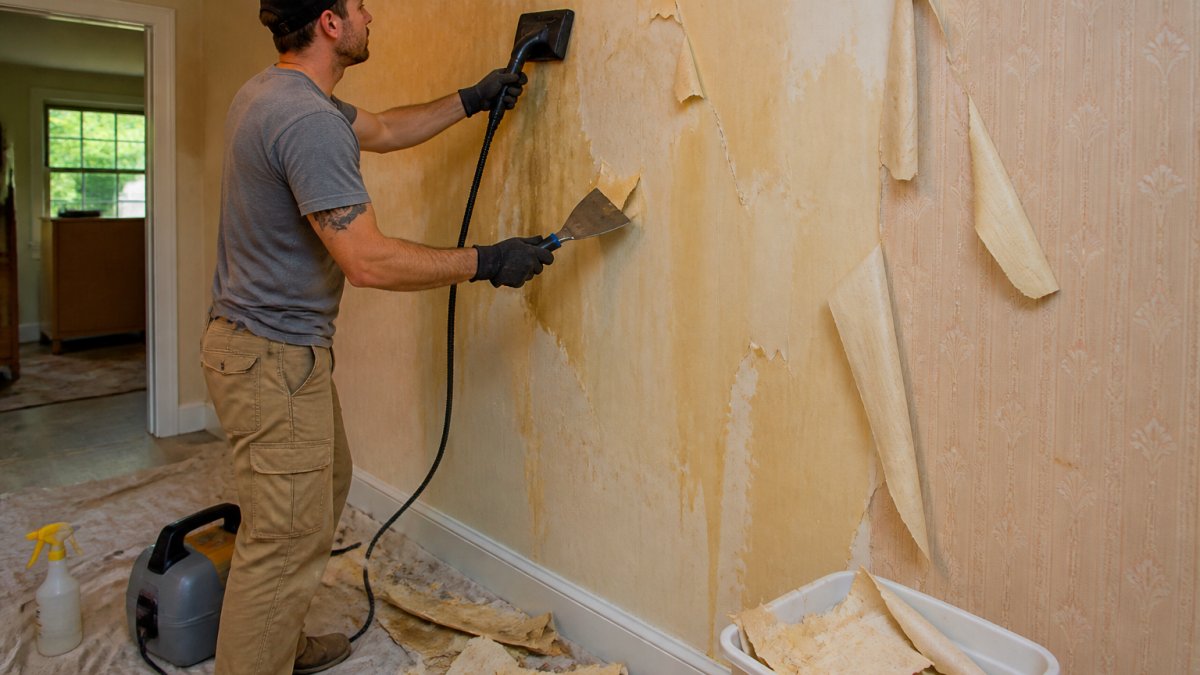 Homeowner in work clothes using a steamer and scraper on a wall with peeling wallpaper, drop cloths and tools nearby, showing the mess and effort of DIY removal
Here is how the two approaches compare on the same mid-size job, a 12-by-15-foot bedroom with roughly 400 square feet of wall area and one layer of strippable paper over painted drywall:
| Cost Line | DIY Removal | Professional Removal |
|---|---|---|
| Labor | Your time, typically 10-20 hours across two weekends | Included in the quote |
| Removal solution and scoring tool | $25-$60 at a home center | Included |
| Steamer rental | $40-$80 per day, often two days | Included (crew owns equipment) |
| Plastic sheeting, drop cloths, sponges, blades | $20-$40 | Included |
| Disposal | $0 if curbside pickup accepts it; otherwise a dump fee or haul-away charge | Included in most quotes |
| Wall repair (if needed) | Your time, or a separate drywall contractor | Often quoted separately, ask |
| Primer and paint | Same either way | Same either way |
| Risk of damage | Borne entirely by you | Covered by the contractor |
The Hidden Costs of Doing It Yourself
The hidden costs of DIY wallpaper removal are time, one-use tool purchases, and wall damage you did not plan for. Three costs deserve a hard look before you decide:
- The rental clock. A steamer rental runs by the day whether the paper cooperates or not. If a single-layer room turns into a three-day fight because the adhesive was applied over bare drywall, you pay for every one of those days.
- The one-use tool problem. Scoring tools, wide blades, and removal concentrate are inexpensive individually, but they tend to sit in the garage afterward. Count them as a full cost, not a partial one.
- The value of your time. If you would otherwise be working, or if the job eats two weekends you cannot get back, that time has a real cost even though no invoice arrives. A homeowner who bills hourly should price their own labor into the DIY column before comparing it to a quote.
- The damage tail. If the drywall face tears, you are now paying for skim coating, sanding, and priming, work that can rival or exceed the original removal quote. That is the scenario the professional price is partly insuring against.
A like-for-like comparison therefore has two columns, not one: the easy-job column, where DIY usually wins on cash, and the hard-job column, where a torn wall can erase the savings. The next section covers how to tell which column your job belongs in.
How Long Does Wallpaper Removal Take?
Wallpaper removal typically takes a few hours for a small, single-layer room and a full day or more for a large room with multiple layers or vinyl wallpaper.
Strippable wallpaper comes off in large sheets. Traditional paper glued over bare drywall can fight you the whole way. Nonporous vinyl resists the removal solution, so it needs scoring before it will absorb anything.
When Professional Removal Is Clearly Worth the Cost
Professional removal is clearly worth the cost when the wallpaper is vinyl, nonporous, or applied in multiple layers over drywall you intend to keep.
It also makes sense when the room is part of a larger renovation. If a kitchen or bathroom remodel is already underway, folding removal into the project scope keeps one crew accountable for the wall from stripping through priming and paint.
When DIY Makes More Sense
DIY makes more sense when the wallpaper is strippable, the room is small, and the wall underneath is already scheduled for repair or replacement. A single layer of modern strippable paper in a powder room is a weekend job for a careful homeowner with a steamer and patience.
It also fits when budget is the binding constraint and you can accept a longer timeline. Removal is physical work, not technical work, and many homeowners handle easy paper without incident.
Risk-Adjusted Comparison: Wall Damage, Repairs, and Total Project Cost
The risk-adjusted comparison is where the decision usually resolves, because removal is rarely the last step. A DIY removal that goes well costs less than a professional quote. A DIY removal that tears drywall face adds skim coating, sanding, priming, and possibly drywall replacement, and that total can exceed the professional quote before you have picked up a paintbrush.
How Wall Damage Actually Happens
Damage during removal is not random. It follows a few predictable mechanisms:
- Torn drywall face paper. When adhesive bonds tighter to the drywall face than to the wallpaper backing, the paper delaminates and takes the face with it. This is most common with wallpaper applied directly over bare or lightly primed drywall, and with older paper whose adhesive has cured for years.
- Gouges from scraping. A dry scraper dragged across a stubborn seam digs into the drywall. The fix is more soaking, not more pressure, but patience is the variable homeowners most often run out of on day two.
- Soft or crumbly drywall. In older homes, the drywall or plaster underneath may already be fragile. Removal that would be routine on new board can open up repairs on a wall that was barely holding together.
- Incomplete adhesive removal. Residual paste left on the wall shows through primer and paint as a texture or a bonding failure. It has to be washed off before finishing, which adds a step many DIY budgets miss.
What the Follow-Up Work Costs
Removal is the front half of the project. The back half, repair and finish, is where budgets drift. A few common line items to price into both columns:
- Skim coating: a thin coat of joint compound over damaged areas, then sanding. Priced by area and by how much of the wall is affected.
- Patching: filling gouges and small holes before skim coating.
- Priming: a primer coat over bare drywall or repaired areas before paint. Often a separate line item from painting.
- Painting: the same either way, but it cannot start until the wall is sound and sealed.
Ask any contractor whether repair and priming are inside the removal quote or billed separately. On difficult paper, that answer can move the total by more than the removal itself.
The Risk-Adjusted Decision
Put the two columns side by side and the logic is straightforward:
- Easy paper, sound wall, small room: DIY cash cost is low and the damage risk is small. The professional premium buys speed and certainty, not much else.
- Vinyl, nonporous, or multi-layer paper over drywall you intend to keep: the damage risk rises sharply, and a single torn wall can push the DIY total past the professional quote. This is where the professional premium is easiest to justify.
- Older home with fragile walls: the risk is highest and the repair cost is least predictable. A licensed, bonded, and insured contractor carries the damage risk, which is the main thing you are buying.
Factor the follow-up work into both columns before you decide. The question is not whether removal costs less DIY; it is whether the total project, stripping, repair, priming, and paint, costs less once the risk is priced in.
Questions to Ask a Wallpaper Removal Contractor Before You Hire
Ask these questions before signing anything, and ask them in this order:
- Does the quote include wall repair and skim coating if the drywall is damaged?
- Is priming included, or is that a separate line item?
- How is the price structured: flat per room, per square foot, or hourly?
- What is the plan if the wallpaper turns out to have multiple layers?
A contractor who answers these plainly and puts the scope in writing is telling you how the whole project will go.
At SmithFamilyPaintingandProjects, we put removal scope, repair, and finishing in one written estimate so homeowners can see the full project cost before work starts.
The real challenge with wallpaper removal is not the stripping itself. If you are planning a renovation and want the removal, repair, and finishing handled by one accountable crew, call SmithFamilyPaintingandProjects at 434-944-4649.
Frequently Asked Questions
How much should it cost to have wallpaper removed?
Professional removal estimates vary by source: Angi reports a range of $423 to $1,192 with an average of $793, while The Home Depot Pro Referral lists $1 to $4 per square foot including labor, materials, and equipment. RISMedia cites $1 to $3 per square foot or $300 to $800 for a typical space. Actual quotes depend on wallpaper type, layers, room size, and wall condition, so treat these as benchmarks rather than fixed prices.
Can I remove wallpaper myself without damaging the wall?
Sometimes, but it depends on the wallpaper and wall condition. Vinyl or nonporous wallpaper and multiple layers make DIY removal harder, and aggressive scraping can gouge drywall, requiring skim coating and priming before painting. If the wallpaper has been up for decades or the drywall was never primed, the risk of damage rises. A careful DIY approach with steam and patience works best on simple, single-layer paper over sound walls.
How long does professional wallpaper removal take?
Timelines vary with room size, wallpaper type, and the number of layers. A single layer in an average room may take a day, while multiple layers, vinyl wallpaper, or damaged walls can stretch the job to several days, especially if skim coating and priming are needed. Ask your contractor for a schedule in writing so you can plan around the work.
Is it cheaper to remove wallpaper or replace drywall?
Replacing drywall is usually more expensive than removal because it involves demolition, new materials, finishing, and disposal. Professional wallpaper removal typically falls in the $1 to $4 per square foot range, while drywall replacement adds material and labor costs on top. Removal is almost always the lower-cost path unless the drywall is severely damaged or moldy, in which case replacement may be necessary.
What should I ask a wallpaper removal contractor before hiring?
Ask whether the quote includes surface preparation, skim coating, priming, and cleanup, and whether wall repair is extra. Confirm they are licensed, bonded, and insured, request references from similar projects, and ask how they handle unexpected damage. Get the scope and timeline in writing, and clarify how change orders are priced so you avoid surprise costs midway through the project.
Frequently asked questions
How much should it cost to have wallpaper removed?
Professional removal estimates vary by source: Angi reports a range of $423 to $1,192 with an average of $793, while The Home Depot Pro Referral lists $1 to $4 per square foot including labor, materials, and equipment. RISMedia cites $1 to $3 per square foot or $300 to $800 for a typical space. Actual quotes depend on wallpaper type, layers, room size, and wall condition, so treat these as benchmarks rather than fixed prices.
Can I remove wallpaper myself without damaging the wall?
Sometimes, but it depends on the wallpaper and wall condition. Vinyl or nonporous wallpaper and multiple layers make DIY removal harder, and aggressive scraping can gouge drywall, requiring skim coating and priming before painting. If the wallpaper has been up for decades or the drywall was never primed, the risk of damage rises. A careful DIY approach with steam and patience works best on simple, single-layer paper over sound walls.
How long does professional wallpaper removal take?
Timelines vary with room size, wallpaper type, and the number of layers. A single layer in an average room may take a day, while multiple layers, vinyl wallpaper, or damaged walls can stretch the job to several days, especially if skim coating and priming are needed. Ask your contractor for a schedule in writing so you can plan around the work.
Is it cheaper to remove wallpaper or replace drywall?
Replacing drywall is usually more expensive than removal because it involves demolition, new materials, finishing, and disposal. Professional wallpaper removal typically falls in the $1 to $4 per square foot range, while drywall replacement adds material and labor costs on top. Removal is almost always the lower-cost path unless the drywall is severely damaged or moldy, in which case replacement may be necessary.
What should I ask a wallpaper removal contractor before hiring?
Ask whether the quote includes surface preparation, skim coating, priming, and cleanup, and whether wall repair is extra. Confirm they are licensed, bonded, and insured, request references from similar projects, and ask how they handle unexpected damage. Get the scope and timeline in writing, and clarify how change orders are priced so you avoid surprise costs midway through the project.