Interior Paint Finish Cost Per Square Foot Explained
comparison · October 26, 2026 · Editorial Team
Last Updated: October 25, 2026
Quick Summary
Paint finish cost per square foot varies by finish type, wall condition, and project scope, with labor typically accounting for 60-70% of total cost. Flat finishes are least expensive, while satin and semi-gloss cost more per square foot due to higher material prices and increased labor to apply evenly.
- Flat finish is cheapest per square foot but shows dirt easily; satin costs more but resists moisture and cleaning in kitchens and bathrooms.
- Labor accounts for 60-70% of total painting project cost, making finish choice and surface prep critical to final pricing.
- Confirm whether quotes measure floor area, paintable wall area, or full scope including ceilings and trim, as this dramatically changes per-square-foot comparisons.
- A 12x12 room has roughly 348 square feet of paintable wall after deducting door and window openings, not 144 square feet of floor area.
- Request itemized estimates that separate labor, paint, prep work, number of coats, and trim pricing to compare contractor bids accurately.
Table of Contents
- Interior Paint Finish Cost Per Square Foot: The Basics
- Paint Finish Types and Uses by Room
- Interior House Painting Cost Per Square Foot by Scope
- What Affects Your Painting Estimate
- 12x12 Room Painting Cost and Labor Breakdown
- Interior Painting Estimate Checklist
- Getting Your Painting Project Quote
- Frequently Asked Questions
Interior Paint Finish Cost Per Square Foot: The Basics
Understanding paint finish cost per square foot is essential when planning an interior painting project.
Painting estimates break down into labor and materials. Labor typically accounts for 60-70% of total project cost, and the finish you select impacts both material cost and the labor required to apply it properly.
A key distinction in pricing is how contractors calculate square footage: the total wall area being painted, calculated by multiplying wall height by length.
Paint Finish Types and Uses by Room
Most estimates quote a single blended price per square foot, which hides the fact that sheen changes both the paint bill and labor hours. The table below shows the cost mechanics behind each finish.
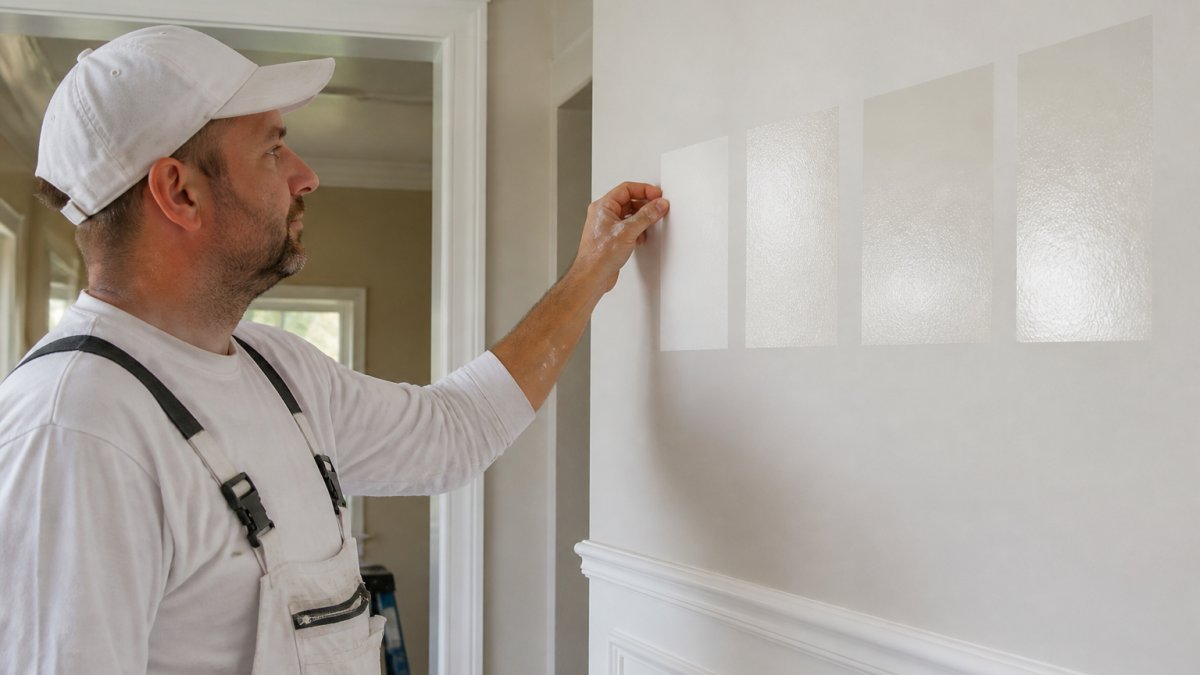 Professional painter examining paint finish samples showing flat, eggshell, satin, and semi-gloss finishes on white wall surface with natural studio lighting
| Finish | Relative paint cost per gallon | Relative labor to apply evenly | Typical wall use | Best-fit rooms |
|---|---|---|---|---|
| Flat / matte | Lowest | Lowest | Low-traffic walls, ceilings | Bedrooms, living rooms, dining rooms, ceilings |
| Eggshell | Slightly above flat | Slightly above flat | Medium-traffic walls | Hallways, family rooms, kids' rooms |
| Satin | Above eggshell | Above eggshell | High-traffic and moisture-prone walls | Kitchens, bathrooms, laundry rooms |
| Semi-gloss | Highest wall-grade sheen | Highest wall-grade sheen | Trim, doors, cabinets, wet areas | Bathrooms, kitchens, trim, doors |
| Gloss | Highest | Highest | Trim, doors, accent features | Doors, trim, cabinetry, accent walls |
Flat Finish
A flat finish has no sheen and produces a matte appearance. It is usually the least expensive finish per square foot: flat paint sits at the low end of a manufacturer's line, and it hides lap marks and roller texture, so fewer touch-ups are needed.
The trade-off is cleanability. Flat paint burnishes when scrubbed and does not wipe clean well, so it is a poor fit for kitchens, bathrooms, hallways, and kids' rooms.
Eggshell Finish
Eggshell has a soft, low-luster sheen between flat and satin. It costs slightly more per square foot than flat because the paint costs more and the higher sheen shows application marks, requiring more back-rolling and touch-ups.
Eggshell adds a modest premium per square foot over flat but usually pays back in rooms that see regular cleaning. It is not the best choice for bathrooms or kitchens, where moisture and grease call for a more washable sheen.
Satin Finish
Satin has a smooth, velvety sheen that reflects more light than eggshell. It is the most common wall finish for kitchens, bathrooms, and laundry rooms because it resists moisture and repeated wiping.
That labor premium is the hidden cost in a satin quote: a wall that takes one pass with flat may need careful back-rolling and extra prep with satin.
Semi-Gloss and Gloss Finishes
Semi-gloss and gloss have the highest sheen and durability. They are standard for trim, doors, cabinets, and moisture-prone surfaces. Both cost more per gallon and demand more skill to apply without visible brush marks, so labor per square foot is highest in this tier.
Gloss is rarely used on large wall areas because it magnifies every imperfection; it is reserved for doors, trim, and accent features. Semi-gloss is the practical wall choice in bathrooms and kitchens where scrubbing is expected.
Interior House Painting Cost Per Square Foot by Scope
Scope significantly affects overall cost per square foot. A walls-only estimate differs substantially from one that includes ceilings, trim, and doors.
According to Homewyse painting cost estimates, site conditions and selected options directly change the final cost. A basic wall repaint costs less per square foot than a project involving surface repairs, primer application, and multiple coats.
When contractors provide estimates, they typically break down costs by scope:
| Scope | Typical Coverage | Cost Factors |
|---|---|---|
| Walls only | Interior wall surfaces | Basic preparation, one or two coats |
| Walls and trim | Walls plus baseboards, crown molding, door frames | Additional linear feet, detail work |
| Walls, trim, and ceilings | Full interior coverage | Highest labor due to ceiling height and access |
| Walls, trim, ceilings, and doors | Complete interior | Most expensive; includes door painting and hardware removal |
Walls alone are the simplest scope and lowest cost per square foot. Trim adds complexity through careful preparation and precise application.
What Affects Your Painting Estimate
Several factors influence final cost per square foot beyond finish type and scope.
Surface Preparation: Wall condition directly impacts labor costs.
Number of Coats: Most interior painting projects require two coats for even coverage and color accuracy (The Best Order to Paint a Room). Some color changes or finishes may require three coats, which increases both material and labor costs.
Ceiling Height: Standard 8-foot ceilings cost less to paint than vaulted or cathedral ceilings.
Color and Paint Quality: Premium paint costs more per gallon but often provides better coverage and durability.
Site Conditions: Furniture removal, floor protection, and workspace preparation factor into labor costs.
12x12 Room Painting Cost and Labor Breakdown
A 12x12 room is a useful example because the math is easy to check, but what matters is the paintable wall area and the scope you hire, not the floor area. The same room produces different per-square-foot prices depending on what is included.
Stated assumptions
- Room dimensions: 12 ft by 12 ft, 8 ft ceiling.
- Perimeter: 48 linear ft.
- Gross wall area: 48 ft × 8 ft = 384 sq ft.
Walls-only breakdown
| Line item | Basis | What it covers |
|---|---|---|
| Surface prep | Per sq ft of wall | Light sanding, spot patching, caulk at trim |
| Primer | Per sq ft, only if needed | Bare drywall, stain blocking, drastic color change |
| Labor, finish coats | Per sq ft of wall | Rolling and cutting in two coats |
| Paint | Per gallon | Roughly 1 gallon for 348 sq ft at 350-400 sq ft per gallon |
| Protection and cleanup | Flat or per room | Drop cloths, tape, furniture moving, debris removal |
At 348 sq ft of wall, one gallon is usually enough for two coats in a like-for-like color change, but a dramatic change or porous surface can push it to two gallons. That is why a flat paint allowance is hard to compare against a per-gallon line.
How the square-foot number changes the quote
This is the biggest source of apples-to-oranges bids. Three contractors can quote the same 12x12 room at three different per-square-foot prices because they measure different things:
- Floor area basis: 144 sq ft. A quote stated this way looks cheap per square foot but usually excludes walls, ceilings, and trim.
- Paintable wall basis: about 348 sq ft after deducting openings. This is the most common basis for a walls-only quote.
- Full scope basis: walls plus ceiling (about 144 sq ft) plus trim linear footage plus door faces. This produces the highest square-foot count and the highest total, but it is the only number that compares to a full-room repaint.
Adding scope to the same room
| Scope added | What changes | Effect on the quote |
|---|---|---|
| Ceiling | Adds about 144 sq ft of overhead work | Higher labor per sq ft due to overhead access and roller work |
| Baseboards and crown | Priced by linear ft, not sq ft | Adds detail labor and a separate sheen (often semi-gloss) |
| Door and door frame | Priced per door | Hardware removal, edges, and brush work |
| Window trim | Priced per window | Cutting in and detail work |
A walls-only job can easily double in total price once ceilings, trim, and doors are added, even though wall square footage never changes. The per-square-foot headline number is only useful when scope is stated alongside it.
What a like-for-like quote should show
Ask for a quote that separates labor, paint, prep, number of coats, ceilings, trim, doors, and exclusions. A total plus a square-foot rate tells you nothing about coats, primer, or trim pricing. Only the itemized version can be compared line by line against another bid.
Interior Painting Estimate Checklist
When requesting and evaluating painting estimates, use this checklist to ensure you're comparing like-for-like proposals:
- Confirm the exact square footage being painted (walls only vs. full scope)
- Verify which paint finish is included in the estimate
- Check whether surface preparation (patching, sanding, primer) is included
Comparing estimates is easier when all contractors provide the same detail. Request itemized quotes that break down labor, materials, and additional charges separately.
Getting Your Painting Project Quote
When you're ready to move forward, the next step is connecting with a qualified contractor who can assess your situation and provide an accurate estimate.
At SmithFamilyPaintingandProjects, we specialize in interior painting and remodeling throughout Southside Virginia. Our team provides detailed, itemized estimates that break down costs transparently.
Get a detailed painting estimate from our team.
As a licensed, bonded, and insured Class A contractor, we deliver reliable, high-quality work that meets your budget and timeline.
Frequently Asked Questions
What is the average cost to paint the interior of a 1,500 square foot home?
Interior painting costs depend on paint finish, surface preparation, ceiling height, and whether trim and ceilings are included. A 1,500 square foot home typically ranges from $2 to $6 per square foot for walls alone, with higher costs when adding trim, ceilings, and doors. Walls-only projects run lower; full-interior work with multiple finishes costs more. Your actual project cost depends on site conditions, number of coats needed, and finish selection. Contact a local contractor for a detailed estimate based on your home's specific requirements.
How much would a painter charge to paint a 12x12 room?
A 12x12 room (144 square feet) with 8-foot ceilings contains roughly 384 square feet of wall space. At $2 to $6 per square foot for walls alone, the cost ranges from $768 to $2,304. Adding ceiling and trim work increases the total. Labor typically represents 60-80% of the cost, with paint and materials making up the remainder. Finish type, surface condition, and primer needs affect the final price. Get a quote from a professional painter who can assess your walls and recommend the appropriate prep work and finish.
Does paint finish affect the cost per square foot?
Yes, paint finish significantly affects cost per square foot. Flat finishes are typically the least expensive because they require fewer coats and less labor. Eggshell and satin finishes cost more due to additional preparation and application steps. Semi-gloss and gloss finishes are the most expensive because they demand meticulous surface preparation, multiple coats, and skilled application to avoid visible brush marks. Premium paint quality also raises per-square-foot costs. Your finish choice should balance durability, washability, and maintenance needs with your budget.
What factors besides paint finish affect an interior painting estimate?
Key factors include surface preparation (patching, sanding, repairs), ceiling height, number of coats required, primer needs, color changes, existing paint condition, and whether doors, trim, and ceilings are included. Site conditions like moisture, mold, or structural damage raise costs. Labor rates vary by region and contractor experience. Material costs depend on paint quality and brand. A professional estimate accounts for all these variables. Use an interior painting estimate checklist to compare quotes and ensure each contractor is pricing the same scope of work.
Which interior paint finish is the most affordable?
Flat finish is the most affordable option because it covers imperfections well, requires fewer coats, and takes less labor to apply. Eggshell is the next step up in cost but offers better washability. Satin finishes cost more but provide durability for high-traffic areas. Semi-gloss and gloss are the most expensive due to demanding application requirements. However, choosing the cheapest finish may cost more long-term if it requires frequent repainting or fails in high-moisture areas like bathrooms. Balance upfront cost with the finish's durability and maintenance needs for your specific room.
Getting an accurate painting estimate requires understanding how finish types, room size, and scope affect costs. By breaking down the per-square-foot calculation and comparing detailed quotes from qualified contractors, you can make confident decisions about your interior painting project. The investment in quality work and the right finish for each space pays dividends in durability and appearance over time.

Frequently asked questions
What is the average cost to paint the interior of a 1,500 square foot home?
Interior painting costs depend on paint finish, surface preparation, ceiling height, and whether trim and ceilings are included. A 1,500 square foot home typically ranges from $2 to $6 per square foot for walls alone, with higher costs when adding trim, ceilings, and doors. Walls-only projects run lower; full-interior work with multiple finishes costs more. Your actual project cost depends on site conditions, number of coats needed, and finish selection. Contact a local contractor for a detailed estimate based on your home's specific requirements.
How much would a painter charge to paint a 12x12 room?
A 12x12 room (144 square feet) with 8-foot ceilings contains roughly 384 square feet of wall space. At $2 to $6 per square foot for walls alone, the cost ranges from $768 to $2,304. Adding ceiling and trim work increases the total. Labor typically represents 60-80% of the cost, with paint and materials making up the remainder. Finish type, surface condition, and primer needs affect the final price. Get a quote from a professional painter who can assess your walls and recommend the appropriate prep work and finish.
Does paint finish affect the cost per square foot?
Yes, paint finish significantly affects cost per square foot. Flat finishes are typically the least expensive because they require fewer coats and less labor. Eggshell and satin finishes cost more due to additional preparation and application steps. Semi-gloss and gloss finishes are the most expensive because they demand meticulous surface preparation, multiple coats, and skilled application to avoid visible brush marks. Premium paint quality also raises per-square-foot costs. Your finish choice should balance durability, washability, and maintenance needs with your budget.
What factors besides paint finish affect an interior painting estimate?
Key factors include surface preparation (patching, sanding, repairs), ceiling height, number of coats required, primer needs, color changes, existing paint condition, and whether doors, trim, and ceilings are included. Site conditions like moisture, mold, or structural damage raise costs. Labor rates vary by region and contractor experience. Material costs depend on paint quality and brand. A professional estimate accounts for all these variables. Use an interior painting estimate checklist to compare quotes and ensure each contractor is pricing the same scope of work.
Which interior paint finish is the most affordable?
Flat finish is the most affordable option because it covers imperfections well, requires fewer coats, and takes less labor to apply. Eggshell is the next step up in cost but offers better washability. Satin finishes cost more but provide durability for high-traffic areas. Semi-gloss and gloss are the most expensive due to demanding application requirements. However, choosing the cheapest finish may cost more long-term if it requires frequent repainting or fails in high-moisture areas like bathrooms. Balance upfront cost with the finish's durability and maintenance needs for your specific room.