How to Vet Local Contractors: 7 Steps to Hire Safely
ultimate-guide · September 14, 2026 · Editorial Team

Table of Contents
- What You'll Need Before You Start Vetting
- How to Verify a Contractor License Online
- Verify Proof of Insurance, Bonding, and Financial Stability
- Questions to Ask a Contractor Before Hiring
- Contractor Reference Check Template
- Red Flags When Hiring a Contractor
- Contract Analysis, Permits, and Digital Footprint Checks
- Frequently Asked Questions
Last Updated: September 14, 2026
What You'll Need Before You Start Vetting
Learning how to vet local contractors starts with assembling paperwork before you make a single phone call: your project scope, a written budget range, a timeline, and the verification documents you'll request from every candidate you plan to vet local contractors with.
Having these ready speeds up the process and signals you're a serious homeowner.
Here's your pre-vetting checklist:
- Written project scope (what you want done, materials, finish level)
- Budget range and financing status
- Target start and completion dates
- A dedicated folder for licenses, insurance certificates, and references
- A notebook or spreadsheet for comparing bids side by side
Homeowners who skip this step often end up comparing apples to oranges. A contractor who bids on a vague description may overprice the job or hit you with change orders.
How to Verify a Contractor License Online
Verifying a contractor license online is the fastest way to separate legitimate businesses from operators who disappear mid-project. Every state runs a free licensing board database, and most publish results without an account. The trick is knowing which board to search and what the results mean.
Start by identifying the correct authority. General building contractors are usually regulated by a state licensing board (for example, the Department of Professional and Occupational Regulation in Virginia, the Contractors State License Board in California, or the Texas Department of Licensing and Regulation). But specialty trades, electricians, plumbers, HVAC technicians, roofers in some states, are often licensed by a separate board or by the city and county where the work happens. A no-result search doesn't mean the contractor is unlicensed; it means you searched the wrong place.
Find the right board by searching "[your state] contractor license lookup" and confirming the domain ends in .gov or is the official board site. Third-party aggregators cache stale data, so always confirm on the government source.
Checking State Licensing Board Records
Search the licensing board using the contractor's legal business name, not the name on their truck. Many companies operate under a trade name that differs from their registered entity, so a trade-name search can return nothing even when the contractor is properly licensed.
Look for four things: active status, the correct license class for your project size, an expiration date past your project timeline, and a clean disciplinary record. Most boards publish complaint history, disciplinary actions, and suspensions in the same tool. A single resolved complaint differs from a pattern of unresolved ones.
License classifications matter more than most homeowners realize. A Class A or unlimited license typically covers projects of any value, while Class B and C licenses carry per-project dollar limits (commonly in the tens of thousands, varying by state) (Licensing Classifications). If the license class doesn't match your project scope, walk away, an under-licensed contractor may not be able to pull your permit.
Confirming Business Registration and Physical Address
Cross-check the contractor's address against your state's business registration database (usually run by the Secretary of State) and their license record. A mismatch between the license address, business filing, and physical location is a red flag worth investigating before you sign anything.
Drive by the address if it's local. A legitimate contractor has a real office, warehouse, or yard. A PO box alone deserves scrutiny, though a home-based sole proprietor with a registered address is not automatically a problem.
Reciprocity, Expired Licenses, and Out-of-State Contractors
Some states have reciprocity agreements letting a licensed contractor from a neighboring state work without full re-licensing; others require separate registration. If your contractor is based across a state line, confirm they hold an active license in your state, a license valid where they live may not be valid where your project is.
Also check the expiration date. A contractor whose license lapsed last month is operating illegally even if they were licensed for years. Set a calendar reminder to re-verify before work begins if your project is months out.
Verify Proof of Insurance, Bonding, and Financial Stability
Proof of insurance protects you when something goes wrong on your property. Ask for a certificate of insurance directly from the contractor's insurance agent, not a photocopy the contractor hands you.
Call the agent to confirm the policy is active and covers general liability. This one call prevents an injured worker or damaged property from becoming your financial responsibility.
Liability Coverage, Workers Compensation, and Bonding
General liability insurance covers property damage and third-party injuries; workers compensation covers injuries to the contractor's employees on your property.
If a contractor has no workers compensation and a worker gets hurt, you could face a claim (DWC FAQs for employers). Bonding adds protection if the contractor fails to complete the work or violates permit rules.
Request these documents and verify each one with the issuing agent or surety company:
| Document | What It Covers | How to Verify |
|---|---|---|
| General liability | Property damage, third-party injury | Call the insurance agent |
| Workers compensation | Employee injuries on site | Confirm with state or insurer |
| Surety bond | Non-completion, permit violations | Contact the bonding company |
Financial Stability and Lien History Checks
A contractor's financial health matters more than most homeowners realize. Check your local circuit court clerk's office for recorded mechanic's liens and civil litigation involving the contractor.
Multiple liens suggest a pattern of non-payment to subcontractors and suppliers. If a subcontractor files a lien against your property because the general contractor didn't pay them, you could be on the hook even after paying the general contractor in full (How To Avoid a Home Improvement Scam).
Paying a contractor in full before the work is complete is a common mistake. If the contractor doesn't pay their subcontractors, those subs can file a lien against your home. Always get lien waivers as you make payments.
Questions to Ask a Contractor Before Hiring
The questions you ask before hiring reveal how a contractor operates. A confident professional answers directly; a vague or evasive answer tells you plenty.
Ask these questions in your first meeting:
- What's your license number and class?
- Can you provide a certificate of insurance and your bonding information?
- Who will be on my job site each day, and are they employees or subcontractors?
- How do you handle change orders?
- What's your payment schedule?
- Do you pull the building permits, or do I?
- What warranty do you offer on your work?
- Can you provide three references from projects similar to mine?
Listen carefully to how they answer question three. A contractor who uses unvetted subcontractors without telling you creates accountability gaps. You want to know exactly who's walking through your home.
Contractor Reference Check Template
A structured reference check turns vague praise into useful information. Call at least three references and ask the same questions each time so you can compare answers.
Here's a template you can copy and use:
Contractor Reference Check
Reference name: _______________ Project type and scope: _______________ Project dates: _______________
- Did the contractor finish on schedule? If not, how far off?
- Did the final cost match the written estimate? Were there surprise charges?
- How did the contractor handle problems or changes during the project?
- Was the job site kept clean and safe?
- Did the contractor communicate proactively, or did you have to chase them?
- Would you hire them again for a similar project? Why or why not?
- Is there anything you wish you'd known before hiring them?
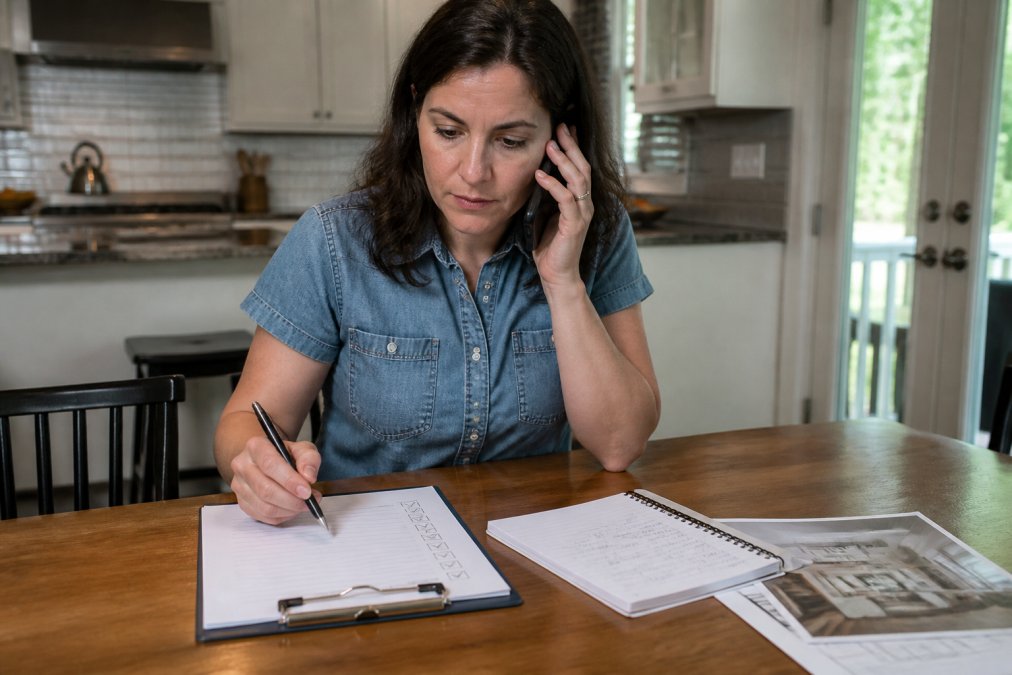 A homeowner sitting at a kitchen table with a clipboard and pen, talking on a smartphone while reviewing a printed reference check list with checkmarks and notes
What to Ask References and How to Read Their Answers
Pay attention to hesitation as much as words. A reference who says "they did fine" without specifics may be holding back. Ask follow-ups: "What would you change about the experience?" and "Was there anything that frustrated you?"
The most valuable reference is someone whose project resembles yours in size and complexity. A homeowner who hired the contractor for a small repair can't speak to how they manage a full kitchen renovation.
Red Flags When Hiring a Contractor
Red flags when hiring a contractor usually appear early if you know what to look for. The most common ones cost homeowners thousands.
Watch for these warning signs:
- Large upfront payment demands. A contractor asking for more than a modest deposit before starting may be funding another job with your money.
- No written estimate. Verbal quotes leave you with no recourse when costs change.
- Pressure to sign immediately. Legitimate contractors don't need same-day decisions.
- No physical address or license number. Both are basic requirements.
- Cash-only payment requests. This removes your paper trail and often signals tax or licensing issues.
- Door-to-door solicitations after storms. Storm chasers move through areas after damage and disappear before warranty issues surface.
Any one of these deserves a pause. Two or more together should end the conversation.
Contract Analysis, Permits, and Digital Footprint Checks
Before you sign anything, read the contract line by line. It's your only enforceable protection if the project goes sideways, yet most homeowners skim it because the language is dense. Here are the clauses that matter, the permit rules that protect you, and the public records that reveal a contractor's history.
Reading the Contract for Hidden Clauses
A solid contractor agreement includes detailed scope of work, a payment schedule tied to milestones, a project timeline, change order procedures, and warranty terms. If any are missing, ask for them in writing before signing. But the clauses that cause the most disputes are the ones homeowners don't think to look for:
- Arbitration and mediation clauses. These can strip your right to sue in court and force disputes into a private process the contractor chooses. They're not automatically bad, but you should know they're there.
- Automatic change-order language. Some contracts let the contractor proceed with changes and bill you later unless you object in writing within a short window. Push for written approval before any change work begins.
- Liquidated damages and delay clauses. These set what happens if the project runs late. A one-sided clause that penalizes you but not the contractor is worth renegotiating.
- Termination and cancellation terms. Know how you can exit the contract and what it costs. A contract with no homeowner termination right locks you in.
- Lien waiver timing. The contract should require the contractor to provide lien waivers from subcontractors and suppliers as payments are made. Without this, a sub who isn't paid can file a lien against your home even after you've paid the general contractor in full.
Read the payment schedule carefully. Progress payments tied to completed milestones (framing done, rough-in inspected, drywall hung) protect you far better than payments tied to calendar dates. Never pay for work that hasn't been completed and inspected.
Photograph every page of the signed contract and any change orders. If a dispute arises later, having dated images on your phone is faster than digging through filing cabinets.
Understanding Building Permits and Local Requirements
Most structural, electrical, plumbing, and mechanical work requires a building permit. Ask who pulls it. A reputable contractor pulls it in their name, so the work gets inspected by your local building department and the permit record becomes public proof the job was done to code.
If a contractor suggests skipping the permit to save time or money, that's a serious red flag. Unpermitted work can complicate future home sales, may void your homeowner's insurance for related claims, and can leave you responsible for bringing the work up to code years later. Check with your county or city building department for local requirements, and confirm the permit is posted once work starts.
Digital Footprint and Online Reputation Verification
A contractor's digital footprint tells you what their references might not. Check Google reviews, the Better Business Bureau, and trade-specific platforms like HomeAdvisor and Angi. But go further than the review sites, public records often reveal more.
Many state and county courts publish civil case records online. Searching the contractor's legal business name in your local court's public access system can surface past lawsuits, judgments, or collection actions. A single lawsuit isn't disqualifying, construction is litigious, but a pattern of judgments for unpaid suppliers or unfinished work is a serious warning sign.
Also check whether the contractor's business name has changed recently. Frequent name changes, new LLCs at the same address, or a pattern of dissolved entities can indicate an attempt to escape a bad reputation or unpaid debts. Your Secretary of State's business search usually shows entity formation and dissolution dates.
Read the negative reviews first. Every business gets a bad review eventually. What matters is how the contractor responded and whether the complaint pattern repeats. Multiple reviews mentioning the same problem, missed deadlines, poor communication, surprise charges, signal a systemic issue rather than a one-off.
Verify that the business name, address, and phone number match across every platform. Inconsistencies can indicate a company that changes names frequently to escape a bad reputation.
Frequently Asked Questions
How do I verify a contractor's license and insurance before hiring?
Ask for the contractor license number and check it on your state licensing board's website. For insurance, request a Certificate of Insurance showing liability coverage and workers compensation, then call the insurer to confirm the policy is active. Also verify bonding through the surety company. Never accept a photocopy alone; confirm directly with the source.
What red flags should I look for when interviewing contractors?
Watch for demands for large upfront cash payments, no written contract, no physical business address, refusal to provide references, and pressure to sign immediately. Other red flags include a license number that doesn't check out, no proof of insurance, and vague answers about project timelines. If a contractor asks you to pull your own building permits or says permits aren't needed, that's a serious warning sign. Trust your instincts and walk away if something feels off.
Should I ask for references from a contractor, and what should I ask?
Yes, always ask for at least three references from recent projects similar to yours. Use a reference check template with questions about quality, timeliness, budget accuracy, and communication. Ask if the contractor showed up when promised, if there were surprise costs, and whether they would hire the contractor again. Also ask about warranty coverage and how the contractor handled any issues. Contact references by phone, not email, to get honest answers.
What is the difference between a licensed, bonded, and insured contractor?
A licensed contractor has met state requirements for knowledge and experience. Bonded means the contractor has a surety bond that protects you financially if they fail to complete the work or violate terms. Insured means they carry liability coverage and workers compensation, protecting you from lawsuits if a worker is injured or property is damaged. All three matter: licensing proves competence, bonding provides financial recourse, and insurance shields you from liability. Always verify all three before signing a contract.
Frequently asked questions
How do I verify a contractor's license and insurance before hiring?
Ask for the contractor license number and check it on your state licensing board's website. For insurance, request a Certificate of Insurance showing liability coverage and workers compensation, then call the insurer to confirm the policy is active. Also verify bonding through the surety company. Never accept a photocopy alone; confirm directly with the source.
What red flags should I look for when interviewing contractors?
Watch for demands for large upfront cash payments, no written contract, no physical business address, refusal to provide references, and pressure to sign immediately. Other red flags include a license number that doesn't check out, no proof of insurance, and vague answers about project timelines. If a contractor asks you to pull your own building permits or says permits aren't needed, that's a serious warning sign. Trust your instincts and walk away if something feels off.
Should I ask for references from a contractor, and what should I ask?
Yes, always ask for at least three references from recent projects similar to yours. Use a reference check template with questions about quality, timeliness, budget accuracy, and communication. Ask if the contractor showed up when promised, if there were surprise costs, and whether they would hire the contractor again. Also ask about warranty coverage and how the contractor handled any issues. Contact references by phone, not email, to get honest answers.
What is the difference between a licensed, bonded, and insured contractor?
A licensed contractor has met state requirements for knowledge and experience. Bonded means the contractor has a surety bond that protects you financially if they fail to complete the work or violate terms. Insured means they carry liability coverage and workers compensation, protecting you from lawsuits if a worker is injured or property is damaged. All three matter: licensing proves competence, bonding provides financial recourse, and insurance shields you from liability. Always verify all three before signing a contract.