How Do You Maximize Kitchen Storage Space?
how-to · October 25, 2026 · Editorial Team
Last Updated: October 24, 2026
Quick Summary
To maximize kitchen storage, divide your kitchen into five task-based zones and assign tools to each based on how you actually cook. Then use vertical space, shelf risers, pull-out drawers, and cabinet door racks to double usable capacity before buying anything new.
- Standard base cabinet shelves sit about 10 to 12 inches apart, often double what mugs or cans need.
- Measure inside width, depth, and clear height before buying a shelf riser so it sits flat.
- Keep heavy items like cast iron low and put daily dishes at waist height.
- A full-extension pull-out converts a 24-inch-deep base cabinet into a visible drawer.
- Start with free moves like decluttering and regrouping before spending on organizers.
Table of Contents
- Start With a Zone-by-Zone Plan for Your Kitchen Storage
- Small Kitchen Storage Ideas That Use the Space You Already Have
- Kitchen Cabinet Organization Ideas That Double Your Cabinet Space
- Kitchen Drawer Organizers That Make Every Drawer Pull Its Weight
- Pantry Organization Ideas That Cut Waste and Clutter
- Put Awkward Corners, Nooks, and Vertical Space to Work
- Match Storage Solutions to Your Kitchen Layout and Budget
- Book a Kitchen Storage Assessment With SmithFamilyPaintingandProjects
- Frequently Asked Questions
Start With a Zone-by-Zone Plan for Your Kitchen Storage
Most homeowners try to buy their way out of a cramped kitchen. They grab a drawer organizer here, a shelf riser there, and hope the clutter disappears. It rarely does. Learning how to maximize kitchen storage space starts with a plan, not a shopping cart. At SmithFamilyPaintingandProjects, we have walked into enough kitchens to know the difference between a room that works and one that just holds more stuff.
Kitchen storage planning is the practice of dividing your kitchen into task-based zones, then assigning tools and space to each zone based on how you actually cook. A good plan doubles usable space before you spend a dollar.
Map Your Kitchen Into Five Working Zones
Every kitchen, big or small, breaks into five zones:
- Prep zone: counter space between sink and stove for chopping and mixing
- Cooking zone: the stove and the pots, pans, and utensils you reach for daily
- Cleaning zone: the sink, dish rack, and under-sink supplies
- Storage zone: pantry, cabinets, and drawers for food and tools
- Serving zone: where plated food and dishes land before they hit the table
Walk your kitchen and note what sits farthest from where you use it. That mismatch is where your storage problem actually lives.
Small Kitchen Storage Ideas That Use the Space You Already Have
Small kitchens force honest choices. In a small kitchen, limited space rewards vertical thinking and punishes horizontal hoarding. The best small kitchen storage ideas use walls, cabinet doors, and the gaps you already own.
Try these first:
- Hang a rail or pegboard on any bare wall for utensils, mugs, and small pans
- Mount hooks inside cabinet doors for measuring spoons and lids
- Stack storage containers in one dedicated cabinet instead of scattering them
- Slide a slim rolling cart beside the fridge or into a gap under the counter
- Use the space above the fridge for rarely used items in labeled bins
Rental-Friendly and No-Drill Options
Renters cannot punch holes in walls. That does not mean limited storage. Self-adhesive hooks, tension rods, and over-the-door racks handle most jobs without a single screw. Command-style strips hold well on clean, smooth surfaces, though heavy cast iron needs a real anchor. A freestanding rolling cart gives you extra workspace and storage that moves with you when the lease ends.
Kitchen Cabinet Organization Ideas That Double Your Cabinet Space
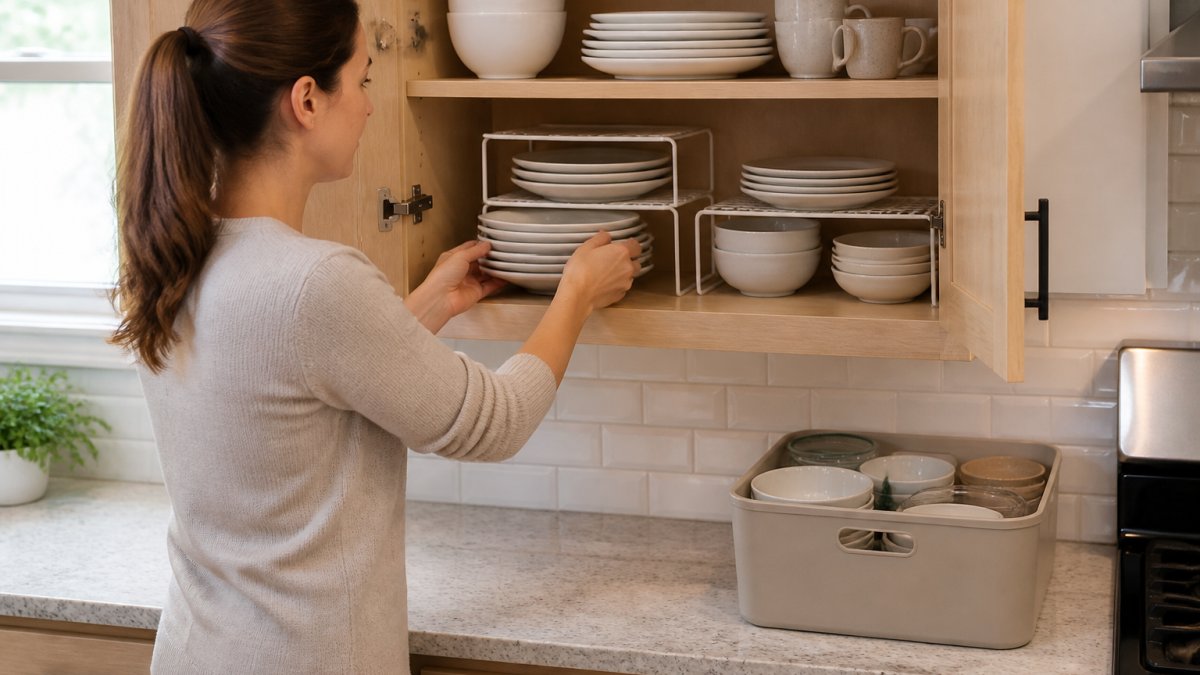 A homeowner standing at open kitchen cabinets, arranging shelf risers and stacked plates while a labeled storage bin sits on the counter nearby
The fastest gain in any kitchen hides behind closed doors. Kitchen cabinet organization ideas work because cabinets waste vertical air. A standard base cabinet shelf sits about 10 to 12 inches apart, and a standard upper cabinet shelf about 10 inches apart, enough for a dinner plate but often double what a stack of mugs or a row of cans actually needs. A shelf riser turns one shelf into two.
Measure Before You Buy a Single Riser
Pull one shelf out and measure three things: the inside width, the inside depth, and the clear height between shelves. Write them down. Most shelf risers are sold in standard widths, and a riser that is half an inch too wide will not sit flat. A common pattern is to buy a riser, discover it does not fit, and return it, measuring first avoids that trip.
Set Adjustable Shelves to the Height of What You Store
Adjustable shelving lets you set heights to match what you store. The mechanism is simple: most cabinets have a series of peg holes on the side panels, and you move the shelf clips up or down. A practical rule is to give tall items, cereal boxes, oil bottles, stock pots, the top or bottom position, and give short items the middle. If your cabinets do not have adjustable holes, a shelf riser or a stackable insert is the workaround.
Bring the Back of the Cabinet Forward
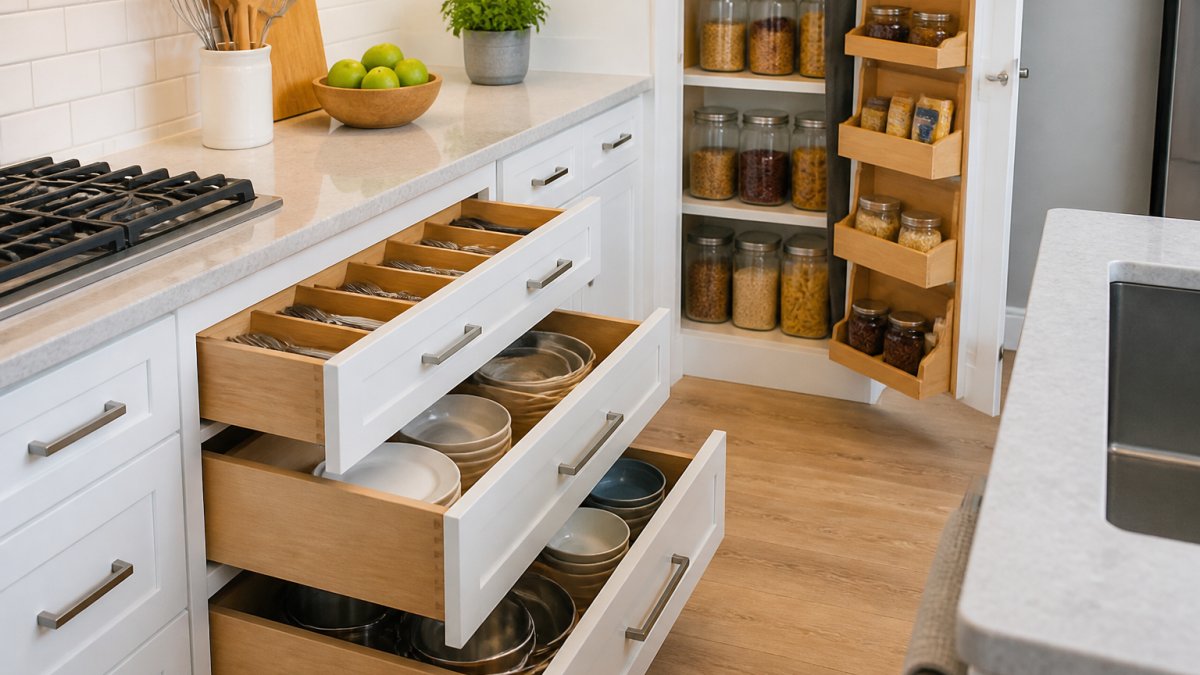
Pull-out drawers bring back-of-cabinet items into easy reach. A full-extension pull-out is the highest-impact upgrade for a deep base cabinet because it converts a 24-inch-deep cave into a drawer you can see into. A cheaper alternative is a half-depth pull-out or a sliding basket that lets you reach the front half without kneeling.
Group Like With Like, and Keep Heavy Items Low
Group like with like: baking supplies in one cabinet, canned goods in another, and everyday dishes where your hand naturally lands. Watch out: overloading a high shelf with heavy items invites a collapse and a mess, so keep the cast iron low. A common pattern is to put daily dishes at waist height, baking and small appliances on the upper shelves, and heavy pots and bulk goods on the bottom shelf or in a pull-out.
Cabinet Door Space Counts Too
The inside of a cabinet door is free real estate. A shallow over-the-door rack holds lids, cutting boards, foil, and plastic wrap. A magnetic strip mounted inside the door holds measuring spoons and small knives. These additions cost little and do not require drilling into the cabinet face.
When a Cabinet Is Beyond Organizing
If a shelf sags, a cabinet is missing, or the layout forces you to store pots in the pantry, no riser will fix it. That is the point where carpentry, a new cabinet, a rebuilt shelf, or a pull-out installation, makes more sense than another trip to the container store.
Here are the key measurements and cabinet moves the article recommends before you buy a single organizer.
| Item | Value | Note |
|---|---|---|
| Standard base cabinet shelf spacing | About 10 to 12 inches apart | Often double what mugs or cans need |
| Standard upper cabinet shelf spacing | About 10 inches apart | Enough for a dinner plate |
| Deep base cabinet depth | 24 inches deep | A full-extension pull-out converts it into a visible drawer |
| Measure before buying a riser | Inside width, inside depth, clear height | A riser half an inch too wide will not sit flat |
| Tall items | Top or bottom shelf position | Cereal boxes, oil bottles, stock pots |
| Short items | Middle shelf position | Set adjustable shelves to what you store |
| Heavy items | Keep low | Overloading a high shelf invites a collapse |
| Daily dishes | Waist height | Baking and small appliances go on upper shelves |
Kitchen Drawer Organizers That Make Every Drawer Pull Its Weight
Drawers are the most abused storage in the house. A drawer organizer with dividers keeps cooking utensils, measuring spoons, and cutlery from becoming a jumbled pile. Deep drawers benefit from a two-tier insert that doubles capacity without adding cabinet space.
Match the organizer to the drawer's job. A shallow top drawer near the stove holds spatulas and tongs. A deep lower drawer holds pots and pans with a divider between them. If you are coming from a kitchen with one junk drawer, expect the first week to feel fussy. After that, you stop digging.
Pantry Organization Ideas That Cut Waste and Clutter
Pantry organization ideas pay off in two ways: you find food before it spoils, and you stop buying duplicates. Clear storage containers let you see what you have at a glance. A first-in, first-out shelf setup keeps older items at the front.
A simple approach:
- Group by category: grains, canned goods, snacks, baking
- Label containers with contents and dates
- Keep a running list of what runs low
- Store heavy bulk items on lower shelves
The USDA food waste guidance notes that careful storage and rotation help households waste less food. A tidy pantry is a money-saving pantry.
Put Awkward Corners, Nooks, and Vertical Space to Work
Awkward corners and dead nooks are where kitchens hide their extra room. A lazy Susan unlocks a deep corner cabinet. A narrow pull-out fits the sliver beside the stove. Open shelving on a bare wall turns vertical space into easy-reach storage.
Above-cabinet space counts too. If your cabinets stop short of the ceiling, add matching bins for seasonal or rarely used items. Watch out: grease and dust collect up there, so keep items sealed and wipe the tops now and then. A hanging pot rack frees cabinet space and puts your most-used pans within arm's reach.
Match Storage Solutions to Your Kitchen Layout and Budget
The right fix depends on your layout. A galley kitchen lives on vertical wall storage and a rolling cart. An L-shaped kitchen gains from corner solutions and a peninsula. A kitchen island or peninsula adds drawers below and workspace above.
Budget matters as much as layout. Start with the free moves: declutter, relocate, and regroup. Then spend on the high-impact pieces first, like drawer organizers and shelf risers. Before you commit to a bigger project, browse our completed project photos to see how storage and layout changes come together in real kitchens.
Book a Kitchen Storage Assessment With SmithFamilyPaintingandProjects
Some storage problems need more than bins. Sagging shelves, a missing pantry, or a layout that fights you every day may call for real carpentry. That is where we come in. SmithFamilyPaintingandProjects is a licensed, bonded, and insured Class A contractor serving homeowners across Southside Virginia, and we have built our reputation on honest communication and skilled workmanship.
We can assess your kitchen, recommend storage that fits your space, and handle the installation from start to finish. When you are ready to stop fighting your kitchen and start using it, book a kitchen storage assessment with our team.
Frequently Asked Questions
How can I increase the storage space in my kitchen without a full remodel?
Start with the space you already have. Add shelf risers to double cabinet shelves, install drawer dividers, hang pots and utensils on wall hooks or a rail, and put a rolling cart in a dead corner. A zone-by-zone plan keeps items near where you use them, so you stop storing things you rarely touch. Most of these fixes need no drilling and can be undone if you rent.
What are the best small kitchen storage ideas for a tight layout?
Go vertical and use the walls. Open shelving above the counter, a hanging pot rack, and self-adhesive hooks free up cabinet and counter space fast. Use the space above the cabinets for rarely used items, add a shelf over the sink area, and choose a slim rolling cart that tucks beside the fridge. Stacking and hanging do more for a small kitchen than buying more containers.
How do I make deep kitchen cabinets easier to use?
Deep cabinets swallow items at the back. Pull-out shelves or sliding baskets bring the back row forward so you can reach everything. Group items by how often you use them, with daily dishes up front and holiday pieces in the back. Lazy Susans work well in corner cabinets, and clear bins with labels stop the guessing. Measure the cabinet depth before you buy any insert.
How should I organize kitchen drawers so they hold more?
Empty each drawer first, then sort by category. Use adjustable dividers to create slots for utensils, measuring spoons, and wrap rolls, and add a tiered insert for cutlery. Keep the most-used tools in the drawer closest to the prep area. A shallow drawer near the stove for spices and a deep drawer for pots and pans lids keeps the workflow smooth and stops clutter from piling up.
Your kitchen does not need to be bigger. It needs to work harder. If you are tired of digging through drawers and stacking pots on the floor, let SmithFamilyPaintingandProjects help. We bring licensed, insured craftsmanship, honest communication, and a full-service approach from first walkthrough to final walkthrough. Get started with SmithFamilyPaintingandProjects and turn the space you have into the kitchen you actually want.

Frequently asked questions
How can I increase the storage space in my kitchen without a full remodel?
Start with the space you already have. Add shelf risers to double cabinet shelves, install drawer dividers, hang pots and utensils on wall hooks or a rail, and put a rolling cart in a dead corner. A zone-by-zone plan keeps items near where you use them, so you stop storing things you rarely touch. Most of these fixes need no drilling and can be undone if you rent.
What are the best small kitchen storage ideas for a tight layout?
Go vertical and use the walls. Open shelving above the counter, a hanging pot rack, and self-adhesive hooks free up cabinet and counter space fast. Use the space above the cabinets for rarely used items, add a shelf over the sink area, and choose a slim rolling cart that tucks beside the fridge. Stacking and hanging do more for a small kitchen than buying more containers.
How do I make deep kitchen cabinets easier to use?
Deep cabinets swallow items at the back. Pull-out shelves or sliding baskets bring the back row forward so you can reach everything. Group items by how often you use them, with daily dishes up front and holiday pieces in the back. Lazy Susans work well in corner cabinets, and clear bins with labels stop the guessing. Measure the cabinet depth before you buy any insert.
How should I organize kitchen drawers so they hold more?
Empty each drawer first, then sort by category. Use adjustable dividers to create slots for utensils, measuring spoons, and wrap rolls, and add a tiered insert for cutlery. Keep the most-used tools in the drawer closest to the prep area. A shallow drawer near the stove for spices and a deep drawer for pots and pans lids keeps the workflow smooth and stops clutter from piling up.