Common Causes of Home Structural Damage
ultimate-guide · October 2, 2026 · Editorial Team
Table of Contents
- What Causes Home Structural Damage
- Foundation Movement and Settlement Issues
- Water Damage and Moisture Infiltration
- Signs of Foundation Failure You Shouldn't Ignore
- How to Prevent Water Damage in Crawl Spaces
- Hiring a Licensed Contractor for Structural Work
- When to Call a Structural Engineer
- Frequently Asked Questions
Last Updated: October 2, 2026
What Causes Home Structural Damage
Understanding the common causes of home structural damage is essential for protecting your investment. Most structural problems develop gradually from environmental factors, poor drainage, soil movement, and deferred maintenance.
Early signs are easy to miss: a small foundation crack or sticking door often indicates serious issues developing beneath the surface.
Foundation Movement and Settlement Issues
Foundation problems stem from how soil beneath your home shifts, settles, and expands based on moisture and temperature. Uneven movement creates differential settlement.
Differential Settlement and Subsidence
Differential settlement occurs when different foundation sections settle at different rates due to non-uniform soil. This creates stress leading to cracks, misaligned doors and windows, and eventual structural failure if unchecked.
Subsidence is gradual sinking of the entire foundation uniformly, caused by soil compaction, underground voids, or decomposition of organic material.
Differential settlement creates visible cracking and misalignment; subsidence is harder to detect initially. Both require professional assessment.
Soil Expansion and Contraction
Clay soils expand dramatically when wet and shrink when dry, putting constant stress on foundations.
Expansive soils generate lateral pressure that cracks or bows concrete walls. Poor drainage worsens the problem by keeping water in contact with soil longer.
Prevention requires managing moisture: proper grading, gutters, and downspouts direct water away; strategic landscaping reduces wet-dry cycles.
Water Damage and Moisture Infiltration
Water weakens concrete, promotes rust, causes wood rot, and enables mold growth. Water infiltration weakens soil bearing capacity and increases hydrostatic pressure against foundation walls.
Hydrostatic Pressure and Drainage Failures
Hydrostatic pressure is the force exerted by water pushing against foundation walls.
Drainage failures cause hydrostatic pressure: clogged gutters, downspouts draining too close to the foundation, or improper grading allow water to accumulate and damage concrete.
Solutions include: clean gutters regularly, extend downspouts 4-6 feet away, ensure proper grading, install perimeter drains if needed, and use sump pumps in basements or crawl spaces.
Signs of Foundation Failure You Shouldn't Ignore
Foundation problems progress through stages; catching them early prevents structural emergencies. Recognizing warning signs is your first defense.
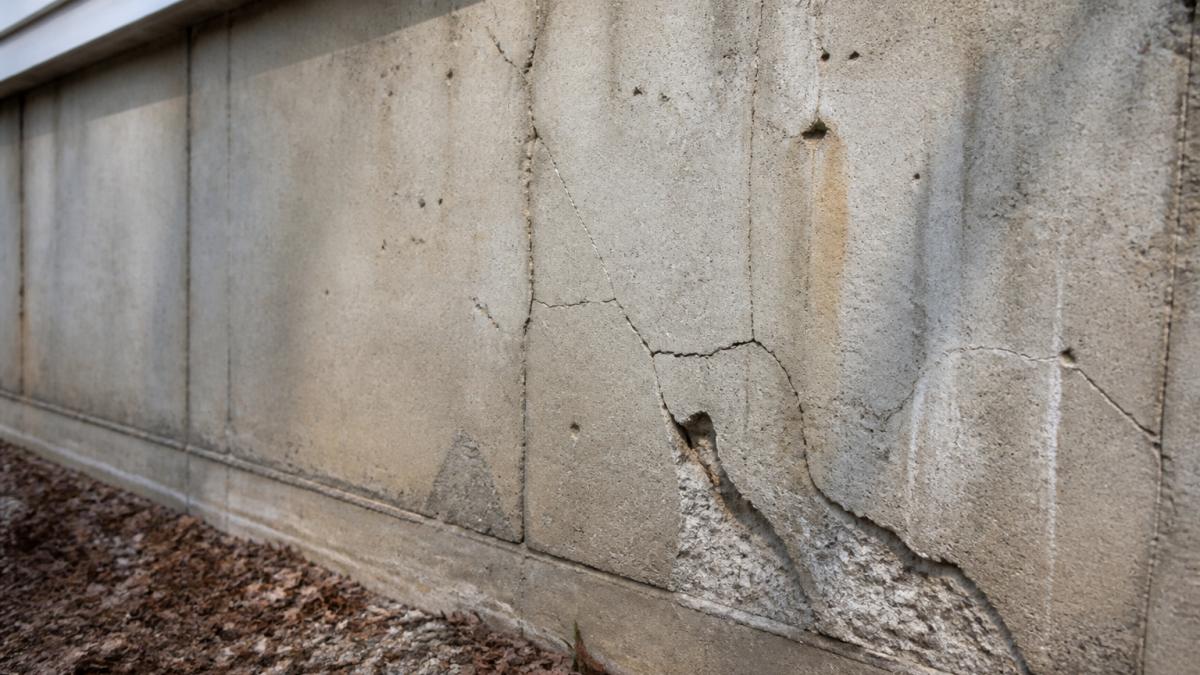 Close-up of concrete foundation wall showing visible hairline cracks, water stains, and spalling concrete damage with natural side lighting highlighting the structural deterioration
Cracks: Hairline vs. Structural
Hairline cracks (less than 1/8 inch) result from normal concrete shrinkage and are cosmetic.
Structural cracks exceed 1/4 inch, follow diagonal or stair-step patterns, and indicate foundation movement. Horizontal cracks suggest lateral pressure; vertical cracks indicate settlement.
Crack location and pattern matter: single cracks suggest localized settlement; multiple cracks suggest broader movement. New or widening cracks indicate active movement requiring professional evaluation.
Doors, Windows, and Floor Problems
Foundation movement causes visible problems: sticking doors, jamming windows, and sloping floors are all red flags.
Sticking doors and windows indicate uneven foundation settlement. Sloping, bouncing, or creaking floors suggest joist deflection or foundation settlement.
| Problem | What It Indicates | Action Required |
|---|---|---|
| Sticking doors/windows | Uneven settlement or frame shift | Professional assessment |
| Sloping floors | Joist deflection or foundation settlement | Structural engineer evaluation |
| Horizontal cracks | Lateral pressure from soil/water | Immediate professional inspection |
| Multiple diagonal cracks | Differential settlement | Structural engineer consultation |
How to Prevent Water Damage in Crawl Spaces
Crawl spaces are vulnerable to water damage, leading to rot, rust, and mold. Prevention is more cost-effective than remediation and depends on regional soil type and climate.
Understanding Your Regional Risk Factors
Prevention strategy depends on soil type: clay soils need aggressive exterior drainage and sump backup; sandy soils require water table control; high water table areas need interior sump and perimeter drains. Contact your county extension office to identify your soil type.
Exterior Drainage: The First Line of Defense
Ensure water slopes away from the house at minimum 5 percent grade (1/2 inch drop per 10 feet) for at least 10 feet.
Gutters and downspouts: Clean gutters twice yearly. Extend downspouts 4-6 feet away (10 feet in clay soils).
Perimeter drain systems: Install if water problems persist.
Sump pump systems: Install in the lowest crawl space point. A float switch triggers discharge at least 10 feet away.
Interior Moisture Control
Even with excellent exterior drainage, some moisture will enter your crawl space.
Vapor barriers: Install 6-mil polyethylene over soil with 12-inch overlaps, extending 6-12 inches up walls. Cost: $1,000-$3,000.
Dehumidification: Sealed crawl spaces with dehumidifiers maintain humidity below 60 percent, preventing mold and rot. Cost: $400-$800.
Insulation: Insulate the rim joist in vented crawl spaces or foundation walls in sealed crawl spaces to prevent condensation.
Regular Inspection and Early Detection
Inspect crawl spaces twice yearly for standing water, damp insulation, mold, wood rot, rust, or efflorescence. Address problems immediately; early detection saves thousands.
Climate-Specific Considerations
Regional considerations: Southeast, use sealed crawl spaces with dehumidifiers. Northeast/Midwest, ensure sump discharge won't refreeze; add battery backup. Coastal, install interior sump and perimeter drains; use corrosion-resistant metals. Southwest, size drainage for peak rainfall, not average.
Hiring a Licensed Contractor for Structural Work
Structural repairs require professionals, but not all require contractors. Understanding when to call an engineer versus a contractor saves thousands and prevents misdiagnosis.
When You Need a Structural Engineer vs. a Contractor
A structural engineer diagnoses and designs solutions; a licensed contractor executes them. Call an engineer if you notice multiple cracks, active widening, noticeably sloping floors, widespread sticking doors/windows, water intrusion on multiple walls, or uneven settlement.
Skip the engineer for single hairline cracks, localized water damage with known cause, isolated sticking doors/windows, or preventive drainage improvements.
Evaluating and Vetting Contractors
Verify credentials: confirm Class A license (check state board for current status and no disciplinary history), request $1M liability and workers' comp insurance (call to verify), get three references from past two years, obtain detailed written estimates from two contractors breaking down labor, materials, equipment, timeline, and warranty.
Red Flags That Should Disqualify a Contractor
- Pressure to sign a contract on the first visit
- Unwillingness to provide references or license information
- Estimates that are significantly lower than others (often indicates corner-cutting)
- No written warranty or unclear warranty terms
- Reluctance to discuss how work will be inspected or verified to code
- Cash-only payment terms
- No physical business address or only a cell phone contact
Understanding Structural Repair Costs
Homeowners often delay repairs because they don't understand the cost range, which leads to worse damage and higher eventual costs. Here are realistic ranges for common structural repairs:
Foundation crack repair (epoxy injection or polyurethane sealing): $500-$2,500 per crack, depending on crack length and width. A single structural crack typically costs $1,000-$1,500 to seal properly.
Foundation wall bowing or lateral pressure repair: $3,000-$15,000+.
Sump pump installation: $1,500-$3,500 for a new system, including pump, basin, discharge line, and check valve.
Crawl space encapsulation (vapor barrier, dehumidifier, sealing): $3,000-$8,000 depending on crawl space size and existing moisture damage.
Underpinning or foundation stabilization: $5,000-$25,000+.
Roof structural repair (sagging, rotted beams, joist replacement): $2,000-$10,000+ depending on extent and materials.
These ranges assume standard residential construction.
Insurance and Structural Damage
Understanding what your homeowners insurance covers is essential before you pay for repairs out of pocket. Most homeowners policies cover sudden, accidental structural damage (e.g., a tree falling through your roof, foundation damage from an earthquake if you have earthquake coverage). They typically do NOT cover:
- Damage from poor maintenance or deferred maintenance
- Gradual settlement or foundation movement
- Water damage from poor drainage or lack of gutter maintenance
- Damage from expansive soil movement
- Damage from lack of proper ventilation or moisture control
Before hiring a contractor, contact your insurance agent and describe the damage. Ask specifically whether it's covered and what documentation you'll need.
SmithFamilyPaintingandProjects brings family-owned experience to structural repairs. As a licensed, bonded, and insured Class A contractor, we handle everything from foundation stabilization to water damage remediation with the attention to detail that protects your home for years to come.
When to Call a Structural Engineer
A structural engineer is a licensed professional who specializes in analyzing building systems and designing solutions for structural problems.
An engineer's report becomes your roadmap for repairs.
The cost of a structural engineer's assessment, typically several hundred dollars, is an investment that prevents expensive mistakes.
Structural damage develops quietly, often over months or years, before it becomes impossible to ignore.
If you're dealing with foundation cracks, water damage, sloping floors, or any of the warning signs covered here, don't wait. Contact a licensed structural engineer for professional assessment. When you're ready to address the problem, SmithFamilyPaintingandProjects stands ready with licensed, bonded, insured expertise and 24/7 emergency availability. Call 434-944-4649 for a consultation.
Frequently Asked Questions
What are the early warning signs of structural damage in a home?
Early warning signs include hairline cracks in drywall or concrete, doors and windows that stick or don't close properly, sloping or uneven floors, and visible gaps between walls and ceilings. Water stains, musty odors, and bowing walls indicate moisture infiltration or foundation movement. The sooner you identify these signs, the easier and less expensive the remediation becomes. If you notice multiple warning signs, contact a structural engineer for a professional assessment.
How does soil movement cause structural damage?
Soil expansion and contraction from moisture changes, freeze-thaw cycles, and temperature fluctuations create uneven pressure on your foundation. Differential settlement occurs when different parts of the foundation sink at different rates, stressing load-bearing walls and the building envelope. Clay soils are particularly prone to expansion, while sandy soils may settle unpredictably. These movements are often unavoidable, but proper drainage systems and foundation design can minimize their impact on your home's structural integrity.
Can I assess structural damage myself, or do I need a professional?
You can identify visible warning signs like cracks, sticking doors, and water damage, but determining whether damage is cosmetic or structural requires professional expertise. A licensed structural engineer uses forensic engineering methods to assess load-bearing walls, foundation soundness, and hidden damage. For anything beyond surface-level observation, especially foundation issues, roof sagging, or joist deflection, hire a licensed contractor or structural engineer. Early professional assessment often prevents costly repairs later.
Will homeowners insurance cover structural damage repairs?
Most homeowners insurance covers sudden, accidental structural damage (like from storms or fires) but excludes damage from poor maintenance, natural settling, or gradual water infiltration. Foundation damage, subsidence, and moisture-related issues are typically not covered unless caused by a named peril. Coverage varies by policy, so review your specific terms or contact your insurer. For preventive repairs and maintenance-related damage, budget separately or consult a licensed contractor about financing options.
Frequently asked questions
What are the early warning signs of structural damage in a home?
Early warning signs include hairline cracks in drywall or concrete, doors and windows that stick or don't close properly, sloping or uneven floors, and visible gaps between walls and ceilings. Water stains, musty odors, and bowing walls indicate moisture infiltration or foundation movement. The sooner you identify these signs, the easier and less expensive the remediation becomes. If you notice multiple warning signs, contact a structural engineer for a professional assessment.
How does soil movement cause structural damage?
Soil expansion and contraction from moisture changes, freeze-thaw cycles, and temperature fluctuations create uneven pressure on your foundation. Differential settlement occurs when different parts of the foundation sink at different rates, stressing load-bearing walls and the building envelope. Clay soils are particularly prone to expansion, while sandy soils may settle unpredictably. These movements are often unavoidable, but proper drainage systems and foundation design can minimize their impact on your home's structural integrity.
Can I assess structural damage myself, or do I need a professional?
You can identify visible warning signs like cracks, sticking doors, and water damage, but determining whether damage is cosmetic or structural requires professional expertise. A licensed structural engineer uses forensic engineering methods to assess load-bearing walls, foundation soundness, and hidden damage. For anything beyond surface-level observation—especially foundation issues, roof sagging, or joist deflection—hire a licensed contractor or structural engineer. Early professional assessment often prevents costly repairs later.
Will homeowners insurance cover structural damage repairs?
Most homeowners insurance covers sudden, accidental structural damage (like from storms or fires) but excludes damage from poor maintenance, natural settling, or gradual water infiltration. Foundation damage, subsidence, and moisture-related issues are typically not covered unless caused by a named peril. Coverage varies by policy, so review your specific terms or contact your insurer. For preventive repairs and maintenance-related damage, budget separately or consult a licensed contractor about financing options.