Benefits of Hiring Family-Owned Contractors
listicle · September 27, 2026 · Editorial Team

Table of Contents
- Why Family-Owned Contractors Build Stronger Relationships
- Tax Advantages and Financial Benefits of Family Employment
- Questions to Ask a Contractor Before Hiring
- How to Vet a General Contractor: What Sets Family Businesses Apart
- Licensed and Insured Contractor Requirements: Accountability That Matters
- Managing Professional Boundaries While Maintaining Personal Trust
- Long-Term Reliability and Succession Planning in Family Businesses
- Frequently Asked Questions
Last Updated: September 27, 2026
Why Family-Owned Contractors Build Stronger Relationships
When you hire a family-owned contractor, you're entering a relationship where the people doing the work have a personal stake in your satisfaction. At SmithFamilyPaintingandProjects, this principle shapes everything we do.
Family businesses operate differently than larger firms. The owner's name is on the door, so their reputation is personal. You're talking to the decision-maker, not waiting for approval from a chain of command.
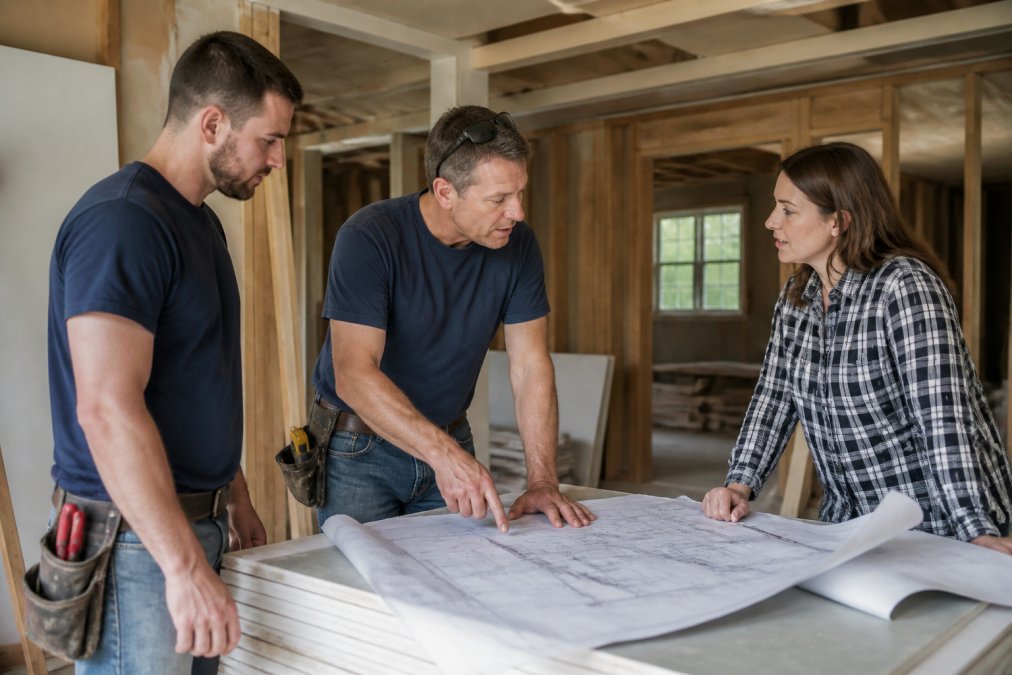 Family contractor team reviewing renovation plans with homeowner at job site, pointing at blueprints and discussing details with direct eye contact and collaborative body language
The trust-based relationships that family-owned contractors build tend to last because they depend on repeat work and referrals. That dependency creates accountability.
Communication improves dramatically when the contractor has skin in the game. There's less corporate bureaucracy and more willingness to adapt to your needs.
Tax Advantages and Financial Benefits of Family Employment
Hiring family members in a contracting business creates specific tax advantages. The IRS allows reasonable pay for family members who work in your business, and that compensation is deductible, though documentation is required.
A family member can be paid as an employee, a contractor, or through a combination of both, allowing you to optimize your tax position based on profitability and personal tax situations.
Family employment enables succession planning with tax efficiency. Hiring family members early creates a natural transition and establishes documentation important for estate or succession valuation.
The payroll compliance requirements for family members are the same as for any employee, they must be reported on tax forms, withholding must be correct, and records must be maintained. Tools like Gusto's payroll platform help manage this complexity for small contracting businesses, ensuring that family employment stays compliant while maximizing legitimate deductions.
Questions to Ask a Contractor Before Hiring
Ask specific questions that reveal how a contractor operates. When hiring a family-owned contractor, add questions addressing the interpersonal dynamics unique to family businesses.
Standard contractor vetting questions:
Ask: "Can you show me your current license and proof of insurance?" Licensing varies by state, but general contractors must typically be licensed and bonded. Insurance protects you if someone is injured on your property.
Ask: "How do you handle cost overruns?" A professional contractor has a clear change order process requiring your written approval before costs exceed the estimate.
Ask about timeline management and request three recent client references. Call them and ask about communication, timeliness, final costs, and whether they'd rehire the contractor.
Family-business-specific questions that prevent relationship breakdown:
Ask: "Who has decision-making authority during the project?" Unclear authority in family businesses creates delays and frustration.
Ask: "How do you handle disagreements about work quality or timeline?" A mature family business will have a clear conflict resolution process. Vague answers signal they haven't thought through professional conflict handling.
Ask: "What's the best way to reach you with project questions?" A contractor using project management software (Asana, Monday.com, or Basecamp) demonstrates intentional separation of personal and professional interactions.
Ask: "What's your process for mid-project additions and pricing?" A contractor who insists on written change orders protects both of you by maintaining clarity.
Ask: "Have you worked with family members as clients?" Their answer reveals whether they understand that family relationships require extra care with communication and documentation.
Ask: "If we're not happy with the project, what's the process for ending the contract?" A contractor who answers calmly has prepared for worst-case scenarios. Defensive answers signal increased risk of personal conflict.
How to Vet a General Contractor: What Sets Family Businesses Apart
Check the Better Business Bureau and online reviews for patterns. Look for consistent mentions of communication, standing behind work, and whether complaints are specific or systemic.
Visit a job site to assess craftsmanship quality and observe how the contractor interacts with their team. Organized sites with clear communication tend to deliver better results.
Ask family-owned contractors about succession planning and long-term business vision. A family business with the next generation involved shows stability and commitment to quality.
Verify they specialize in your project type. Specialization usually means better results because they've solved your exact problem dozens of times.
Licensed and Insured Contractor Requirements: Accountability That Matters
Licensing and insurance are not optional details, they're your primary protection. Understanding what these requirements actually mean helps you evaluate whether a contractor is legitimate.
A licensed contractor has passed exams demonstrating knowledge of building codes and safety regulations. Verify a contractor's license with your state's licensing board online.
General liability insurance protects you if someone is injured on your property (Commercial general liability insurance). Workers' compensation insurance covers the contractor's employees. A contractor without adequate insurance asks you to assume their risk.
Request a Certificate of Insurance before work begins. Verify it directly with the insurance company rather than accepting verbal assurance.
A surety bond guarantees the contractor will complete the work as promised. If they don't, the bonding company compensates you.
Managing Professional Boundaries While Maintaining Personal Trust
Balancing the personal relationship with the professional one determines whether the working relationship stays healthy. A family business relationship carries emotional weight that can damage personal ties if not handled carefully.
Establish clear expectations in writing before work begins.
A detailed contract specifies scope of work, timeline, budget, payment schedule, and change procedures. For family contractors, the contract creates an objective reference point that removes personal feelings from disputes.
Create a communication protocol that separates personal from professional.
If you know the contractor socially, establish which communication channels are for business and which are for personal interaction. For example: "Project questions go to [email or project management app]. Social plans go to text or phone." This prevents the awkwardness of receiving a work complaint during a family dinner or having to discuss a budget overrun via a casual text thread.
Consider using project management software like Asana, Monday.com, or Basecamp for all work-related communication and documentation. These tools create a permanent record of decisions, change requests, and approvals. They also depersonalize communication because everything is documented in a neutral format rather than through phone calls or texts that can be misinterpreted. When a family member can see that a change request was logged and approved in writing, there's less room for "I thought we agreed to..." misunderstandings.
Develop a conflict resolution framework before problems occur.
Agree in advance on how you'll handle disagreements. A simple framework might look like this:
- Identify the specific issue (not the person): "The timeline has slipped by two weeks" rather than "You're not managing your schedule well."
- Reference the contract or agreement: "The contract specified completion by March 15th. We're now looking at March 29th. Let's talk about why."
- Separate the problem from the relationship: "I value our relationship and I want this project to succeed. I also need to understand what changed."
- Agree on next steps in writing: If you agree to a new timeline or a change to the scope, document it as a change order or email confirmation. Don't rely on verbal agreement.
- If you can't resolve it directly, involve a neutral third party: This might be a mediator, a project manager, or even a family member who isn't directly involved in the work. The key is having a predetermined escalation path so that if you disagree, you're not just stuck in a personal conflict.
Avoid mixing personal favors with business transactions.
"Can you just quickly fix this while you're here?" or "I'll pay you next week" creates ambiguity about whether this is part of the contracted work or a favor. Keep the business relationship clean by sticking to the agreement. If you want something added, treat it as a change order. If you need to adjust payment timing, discuss it formally and document the new arrangement.
This boundary protection is especially important with family contractors because the personal relationship can create pressure to be "flexible" or "easy to work with." But flexibility without documentation is how resentment builds. The contractor feels taken advantage of because they did extra work without compensation. You feel frustrated because you thought you were getting something included. A clear boundary prevents both.
Communicate directly about problems immediately.
If you're unhappy with something, say so immediately rather than letting resentment build. A good contractor wants to know if something isn't right so they can fix it. Avoiding difficult conversations out of politeness usually makes things worse, especially with family. The longer you wait, the more the problem festers, and the more likely it is to become personal.
When you do communicate a problem, use specific language: "The paint finish on the north wall has visible brush strokes. I'd like you to sand and repaint it to match the rest of the room" rather than "The paint job doesn't look good." Specific feedback is about the work, not the person. It's easier for a family contractor to hear and act on.
Plan for the possibility that the relationship might need to end.
If the project goes badly, you may need to terminate the contract.
Long-Term Reliability and Succession Planning in Family Businesses
Family businesses that last tend to plan for transition. Understanding a contractor's long-term vision helps you decide whether they're a reliable partner for future projects.
Frequently Asked Questions
What are the main advantages of hiring a family-owned contractor?
Family-owned contractors typically offer direct accountability, personalized communication, and stronger long-term relationships. Since the business owner's reputation is tied to their family name, they have greater incentive to deliver quality work and stand behind their projects. Many family-owned contractors also provide more flexible scheduling and are more willing to take on smaller projects than larger firms.
What tax benefits come with hiring family members in a contracting business?
Hiring family members can provide tax deductions for reasonable wages paid, and there are opportunities for income splitting that may reduce overall tax liability. Consult a tax professional to ensure compliance with IRS regulations and to maximize available deductions.
How do I know if a contractor is properly licensed and insured?
Verify licensing through your state's licensing board or contractor registry. Ask for proof of current liability insurance and workers' compensation coverage, and request the contractor's license number and insurance policy details in writing. A reputable contractor will provide this information without hesitation. Check ratings on the Better Business Bureau and verify bonding status, which protects you if the contractor fails to complete work.
Are family-owned contractors more reliable for long-term projects?
Family-owned contractors often demonstrate stronger commitment to long-term projects because their reputation and family legacy are at stake. They typically have lower employee turnover, which means consistent team continuity throughout your project. However, reliability depends on the individual business. Always check references, verify licensing, and review past customer feedback to assess any contractor's track record, regardless of business structure.
Frequently asked questions
What are the main advantages of hiring a family-owned contractor?
Family-owned contractors typically offer direct accountability, personalized communication, and stronger long-term relationships. Since the business owner's reputation is tied to their family name, they have greater incentive to deliver quality work and stand behind their projects. Many family-owned contractors also provide more flexible scheduling and are more willing to take on smaller projects than larger firms.
What tax benefits come with hiring family members in a contracting business?
Hiring family members can provide tax deductions for reasonable wages paid, and there are opportunities for income splitting that may reduce overall tax liability. Consult a tax professional to ensure compliance with IRS regulations and to maximize available deductions.
How do I know if a contractor is properly licensed and insured?
Verify licensing through your state's licensing board or contractor registry. Ask for proof of current liability insurance and workers' compensation coverage, and request the contractor's license number and insurance policy details in writing. A reputable contractor will provide this information without hesitation. Check ratings on the Better Business Bureau and verify bonding status, which protects you if the contractor fails to complete work.
Are family-owned contractors more reliable for long-term projects?
Family-owned contractors often demonstrate stronger commitment to long-term projects because their reputation and family legacy are at stake. They typically have lower employee turnover, which means consistent team continuity throughout your project. However, reliability depends on the individual business. Always check references, verify licensing, and review past customer feedback to assess any contractor's track record, regardless of business structure.