Alternatives to Ceramic Tile for Bathroom Walls
blog · October 12, 2026 · Editorial Team
Table of Contents
- Why Homeowners Choose Alternatives to Ceramic Tile
- Shower Wall Panels vs Tile: Material Comparison
- Waterproof Bathroom Wall Materials: Key Options
- Bathroom Wall Panels: Installation and Performance
- Bathroom Wall Paint for Wet Areas: Durability and Application
- Cost Comparison: Installation, Maintenance, and Long-Term Value
- Material Suitability by Bathroom Zone and Moisture Level
- Frequently Asked Questions
Last Updated: October 12, 2026
Why Homeowners Choose Alternatives to Ceramic Tile
Alternatives to ceramic tile for bathroom walls have grown popular for practical reasons: ceramic tile needs grout maintenance, can crack from settling, and takes time to install.
The appeal isn't just aesthetics. Non-tile solutions often offer faster installation, fewer seams, easier cleaning, and lower upkeep. Some deliver a seamless surface without grout lines; others mimic stone or concrete without the expense.
Shower Wall Panels vs Tile: Material Comparison
When comparing shower wall panels vs tile, the differences go beyond cost.
Panels install in days instead of weeks, and seamless surfaces mean no grout lines to harbor mold.
Tile offers permanence and design flexibility, with thousands of colors, sizes, and finishes, and resists scratches better than acrylic. High-quality ceramic or porcelain lasts decades.
| Feature | Wall Panels | Ceramic Tile |
|---|---|---|
| Installation Time | 1-3 days | 5-14 days |
| Grout Maintenance | None | Regular cleaning needed |
| Seamless Surface | Yes | No (grout lines present) |
| Repairability | Replace single panel | May require multiple tiles removed |
| Long-term Durability | 15-20 years | 25+ years |
| Design Variety | Limited | Extensive |
| Moisture Resistance | Excellent | Excellent (if grout sealed) |
Waterproof Bathroom Wall Materials: Key Options
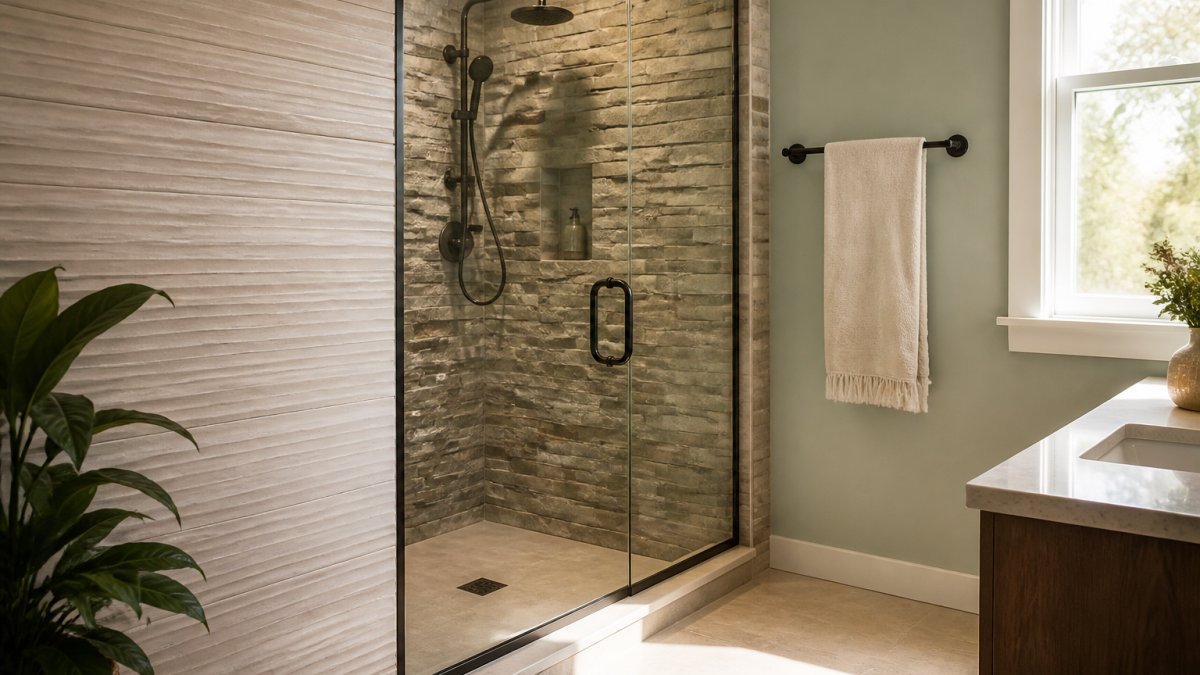 Modern bathroom shower surround displaying multiple wall material finishes including textured wall panels, natural stone veneer, and painted surfaces with warm natural lighting from window
The best waterproof bathroom wall materials resist water penetration and don't degrade when wet. Beyond that, options vary widely in cost, installation complexity, and maintenance.
Acrylic and PVC Wall Panels
Acrylic and PVC panels are engineered plastics molded into large-format sheets that lock together or glue to drywall. Acrylic is slightly more rigid and scratch-resistant than PVC.
Pros: quick installation, no grout, easy cleaning. Cons: they can scratch or dent, aren't as durable as tile over 20+ years, and offer limited design options.
Natural Stone and Stone Veneer
Natural stone, marble, granite, slate, limestone, brings elegance and permanence to bathroom walls. Stone veneer is thinner, lighter stone adhered to a substrate, which reduces weight and cost compared to full-thickness stone.
The appeal: stone is durable, beautiful, and adds perceived value. The reality: it's porous and absorbs water unless sealed every 1-3 years; acidic cleaners etch marble and limestone; installation demands experienced masons; repairs mean replacing entire sections; and stone is heavy, often requiring substrate reinforcement.
Concrete and Exposed Cement Finishes
Concrete and polished cement are trendy in modern bathroom design. Poured or troweled in place, they create seamless, customizable surfaces with options for color, texture, or aggregate.
Concrete is durable, handles moisture well when sealed, and is relatively affordable compared to stone. But it cracks as buildings settle, repairs are visible, sealing must be reapplied periodically, and the industrial look doesn't suit every aesthetic.
Resin and Seamless Surfaces
Epoxy resin and polyester-based finishes create completely seamless wall surfaces with no joints or grout. Sprayed or poured onto prepared walls, they yield a smooth, glossy, or matte finish; some are translucent, allowing embedded objects or lighting effects.
Seamless surfaces are easy to clean, resist mold, and are customizable in color and finish.
Bathroom Wallpaper and Paint Finishes
High-performance bathroom wallpaper and specialized wet-area paints offer an affordable alternative. Modern bathroom wallpaper uses vinyl or non-woven materials that resist moisture; bathroom-rated paints contain mildew inhibitors and moisture-resistant binders.
These options are budget-friendly, fast to apply, and easy to change. The catch: they're not as durable as hard surfaces. Wallpaper can peel at seams if humidity spikes; paint needs recoating every 3-5 years in high-moisture zones.
Bathroom Wall Panels: Installation and Performance
Bathroom wall panels are the fastest-growing alternative to tile because installation is straightforward and performance is predictable.
Installation involves preparing the substrate (flat and dry), applying adhesive, and pressing panels into place.
Performance depends on material quality: budget acrylic panels may yellow or become brittle after 10-15 years, while premium panels last 20+ years.
Bathroom Wall Paint for Wet Areas: Durability and Application
Bathroom wall paint for wet areas differs from standard interior paint.
Application matters as much as product choice: proper prep, cleaning, priming, and a dry surface determine how long paint lasts.
Durability is typically 3-5 years before repainting. In the shower surround, paint may fail faster unless protected by a moisture barrier.
Cost Comparison: Installation, Maintenance, and Long-Term Value
Most articles wave at cost without putting a number on the page. Here is a decision framework built on the three buckets that determine your 10-year outlay: material, installation labor, and recurring upkeep.
The three cost buckets
1. Material cost is what you pay per square foot of finished wall, the number homeowners fixate on and the least predictive of total cost.
2. Installation labor includes substrate prep, waterproofing, cutting, trim, and finish work. On wet-area walls, labor frequently exceeds material cost, sometimes by 2x or more.
3. Recurring upkeep is resealing, regrouting, repainting, and eventual replacement, the bucket competitors ignore and the one that flips the ranking over a 10-year horizon.
Relative cost tiers (material + labor, installed)
Rather than quote region- and season-specific prices, think in tiers. A common pattern across contractor bids:
- Lowest installed cost: bathroom-rated paint over properly primed, moisture-resistant substrate. Wallpaper sits in the same tier when applied to a sound wall.
- Low-to-mid: acrylic and PVC panel systems. Material is inexpensive and installation is fast, which compresses labor.
- Mid: laminate and composite panel systems, large-format porcelain slabs, and quality ceramic or porcelain tile. Labor is the swing factor, both require skilled setters.
current regional remodeling cost data by project type
Labor: the number that surprises homeowners
A few mechanisms drive labor cost more than material choice:
- Substrate prep. Panels and paint can often go over sound drywall. Tile, stone, and concrete usually require cement backer board or a bonded waterproof membrane, adding a demolition and rebuild step.
- Waterproofing. Wet-area walls need a continuous waterproof layer behind the finish. Skipping this step is the most common cause of premature failure, and the most expensive mistake to fix.
- Trim and transitions. Panels need edge trim, corners, and often a matching shower pan or tub apron, costs rarely quoted upfront.
Recurring upkeep: the 10-year math
Here is where the ranking flips. Assume a typical tub-and-shower wall of roughly 60 to 80 square feet:
- Paint: recoat every 3-5 years, two to three cycles over 10 years, plus possible drywall repair if moisture got behind the coating.
- Wallpaper: replace or repair seams within 5-7 years in a humid bathroom, sooner with poor ventilation.
- Ceramic or porcelain tile: ongoing grout cleaning; resealing every 1-3 years is common. Regrouting or replacing cracked tiles is a mid-life expense.
How to decide
Run your own three-bucket estimate before you commit:
- Measure the finished wall area in square feet, including shower surround, tub surround, and accent walls.
- Ask each contractor for a line-item bid separating material, substrate prep, waterproofing, trim, and labor.
- Ask what the finish will need in years 3, 5, and 10, resealing, regrouting, repainting, or replacement.
- Add recurring costs to installed cost for a 10-year total.
For a household moving within five years, low-upkeep panels usually win on total cost. For one staying 15+ years, porcelain tile or properly sealed stone can justify the higher upfront number. The point isn't which material is cheapest, it's which matches your time horizon and tolerance for maintenance.
Material Suitability by Bathroom Zone and Moisture Level
Moisture exposure isn't uniform across a bathroom. The wall behind the showerhead sees direct spray daily; the wall above the towel bar sees incidental humidity. Treating them the same is the most common remodel error. The framework below pairs each zone with the materials that belong there, the waterproofing mechanism that makes them work, and whether the option can go over existing tile.
Zone 1: Direct shower spray
The wettest surface in the room: water hits it at pressure, runs down continuously, and lingers in seams and corners.
What belongs here:
- Ceramic or porcelain tile over a bonded waterproof membrane (roll-on, sheet, or foam board). Grout must be sealed or use an epoxy grout.
- Acrylic and PVC panel systems with sealed seams and a waterproof substrate behind them.
- Laminate and composite panels rated for wet areas, with sealed joints and trim.
What does not belong here: paint, wallpaper, standard drywall, and any finish that relies on the substrate itself to stop water.
Waterproofing mechanism: the finish is the wear layer, not the waterproof layer, the membrane or foam board behind it is.
Zone 2: Tub surround
Moisture is high but not pressurized. Splash, condensation, and steam are the main exposures.
What belongs here:
- All Zone 1 materials.
- Bathroom-rated paint over a waterproof primer and moisture-resistant substrate, provided the paint line is at least 6 inches above the tub rim and the wall is not in the direct splash path of a showerhead.
- Vinyl or non-woven bathroom wallpaper on the upper portion of the wall, away from the tub rim.
Waterproofing mechanism: the substrate and primer block water; the finish is decorative and sacrificial. Expect to recoat or replace sooner than in Zone 3.
Can it go over existing tile? Paint and wallpaper can go over sound, well-bonded tile with the right primer, but grout lines telegraph through unless skim-coated first.
Zone 3: General bathroom walls
Away from the tub and shower, moisture is moderate and intermittent, the most forgiving zone and the best place for finishes that would fail in Zones 1 and 2.
What belongs here:
- Bathroom-rated paint, the workhorse of this zone.
- Bathroom wallpaper in vinyl or non-woven constructions.
- Stone veneer as an accent wall, provided the substrate can carry the weight.
Waterproofing mechanism: none required beyond moisture-resistant substrate and good ventilation. The goal is to manage humidity, not block liquid water.
Can it go over existing tile? Paint and wallpaper can, with proper prep. Veneer and panels can, if the tile is sound and flat.
Zone 4: Bathroom ceiling
Often ignored, always wet. Steam rises and condenses on the ceiling first.
What belongs here: bathroom-rated paint over moisture-resistant drywall, or cement backer board in a steam-heavy shower.
Waterproofing mechanism: ventilation is the primary defense.
Can it go over existing tile? Rarely relevant, but for a tiled ceiling, panels are the practical option because they add minimal weight.
Substrate and installation notes that apply to every zone
- Flatness matters. Panels, large-format tile, and resin systems require a flat substrate, commonly no more than 1/8 inch variation over 10 feet. Check the manufacturer's spec before buying.
- Existing tile as a substrate. Sound, well-bonded tile can serve as a substrate for panels and some resin systems, but not for new tile or stone. Loose or hollow tile must come off.
- Greenboard is not waterproof. Moisture-resistant drywall resists humidity but fails if liquid water reaches it. In Zones 1 and 2, use cement backer board, foam board, or a bonded membrane over the drywall.
Frequently Asked Questions
What can I use on bathroom walls instead of ceramic tile?
Waterproof bathroom wall materials include acrylic and PVC panels, natural stone or stone veneer, concrete, resin, high-gloss paint designed for wet areas, and bathroom-grade wallpaper. Each offers different aesthetics, installation timelines, and maintenance requirements. Panels are grout-free and quick to install; stone adds elegance but requires sealing; paint is budget-friendly but needs proper moisture resistance; resin creates seamless surfaces. Your choice depends on your bathroom zone, moisture exposure, budget, and design preference.
Are shower wall panels better than tile?
Shower wall panels offer distinct advantages over traditional ceramic tile: they're grout-free (eliminating mold growth in grout lines), faster to install, and require less maintenance. Panels resist water damage and need only wiping down. However, tile offers more design variety and can last longer if properly maintained. Panels work best in high-moisture shower surrounds, while tile suits lower-moisture bathroom walls. The best choice depends on your shower's exposure level and your maintenance preferences.
What waterproof bathroom wall materials are easiest to clean?
Acrylic and PVC wall panels are the easiest to maintain, requiring only regular wiping with mild soap and water. Resin and seamless surfaces also clean easily without grout lines to harbor mold. Concrete and stone require periodic sealing and more careful cleaning to avoid staining. High-gloss bathroom paint is wipeable but may show water spots. Wallpaper, while available in waterproof varieties, demands gentle cleaning. If low maintenance is your priority, panels and resin finishes are your best bets for bathroom walls.
Can you use paint instead of tile on bathroom walls?
Yes, but only with proper preparation and high-quality moisture-resistant paint. Bathroom wall paint for wet areas must be specifically formulated with mildew resistance and waterproof finishes. The substrate must be properly sealed and waterproofed first; bare drywall will fail. Paint works well on bathroom walls away from direct shower spray, but direct shower surround areas demand more robust materials like panels or tile. Paint is cost-effective and allows design flexibility, but it requires more frequent touch-ups than tile or panels in high-moisture zones.
Frequently asked questions
What can I use on bathroom walls instead of ceramic tile?
Waterproof bathroom wall materials include acrylic and PVC panels, natural stone or stone veneer, concrete, resin, high-gloss paint designed for wet areas, and bathroom-grade wallpaper. Each offers different aesthetics, installation timelines, and maintenance requirements. Panels are grout-free and quick to install; stone adds elegance but requires sealing; paint is budget-friendly but needs proper moisture resistance; resin creates seamless surfaces. Your choice depends on your bathroom zone, moisture exposure, budget, and design preference.
Are shower wall panels better than tile?
Shower wall panels offer distinct advantages over traditional ceramic tile: they're grout-free (eliminating mold growth in grout lines), faster to install, and require less maintenance. Panels resist water damage and need only wiping down. However, tile offers more design variety and can last longer if properly maintained. Panels work best in high-moisture shower surrounds, while tile suits lower-moisture bathroom walls. The best choice depends on your shower's exposure level and your maintenance preferences.
What waterproof bathroom wall materials are easiest to clean?
Acrylic and PVC wall panels are the easiest to maintain, requiring only regular wiping with mild soap and water. Resin and seamless surfaces also clean easily without grout lines to harbor mold. Concrete and stone require periodic sealing and more careful cleaning to avoid staining. High-gloss bathroom paint is wipeable but may show water spots. Wallpaper, while available in waterproof varieties, demands gentle cleaning. If low maintenance is your priority, panels and resin finishes are your best bets for bathroom walls.
Can you use paint instead of tile on bathroom walls?
Yes, but only with proper preparation and high-quality moisture-resistant paint. Bathroom wall paint for wet areas must be specifically formulated with mildew resistance and waterproof finishes. The substrate must be properly sealed and waterproofed first; bare drywall will fail. Paint works well on bathroom walls away from direct shower spray, but direct shower surround areas demand more robust materials like panels or tile. Paint is cost-effective and allows design flexibility, but it requires more frequent touch-ups than tile or panels in high-moisture zones.