Affordable Alternatives to Custom Bathroom Vanities
blog · October 17, 2026 · Editorial Team
Table of Contents
- Why Homeowners Skip Custom Vanities
- Prefab Bathroom Vanities vs Custom: Cost and Quality Trade-Offs
- DIY Bathroom Vanity Ideas: Converting Furniture on a Budget
- Budget-Friendly Materials: Plywood, MDF, and Reclaimed Wood
- Bathroom Storage Without a Vanity: Alternative Solutions
- Stock vs. Semi-Custom: Finding the Middle Ground
- Installation, Plumbing, and Durability Considerations
- How to Evaluate Ready-Made Vanity Options
- Frequently Asked Questions
Last Updated: October 17, 2026
Why Homeowners Skip Custom Vanities
Custom bathroom vanities offer personalized design and perfect fit, but come with a significant price tag and lengthy timelines. Most homeowners exploring affordable alternatives to custom bathroom vanities discover that budget-friendly options deliver style and function without the expense. At SmithFamilyPaintingandProjects, we've helped countless homeowners in Southside Virginia find creative solutions that fit their renovation budgets while maintaining quality craftsmanship.
The real barrier isn't finding options, it's knowing which path fits your project. Custom vanities require weeks of lead time and a substantial share of renovation costs. Stock vanities arrive ready to install but may not match your exact vision. Semi-custom and repurposed solutions occupy the middle ground, offering flexibility without the full custom price.
Understanding your budget, timeline, and design priorities narrows the field quickly. Alternatives to custom vanities have expanded significantly, and many homeowners find that mixing ready-made components with strategic modifications delivers results that feel custom without the custom price tag.
Prefab Bathroom Vanities vs Custom: Cost and Quality Trade-Offs
Prefab vanities arrive manufactured and ready to install, while custom vanities are built to your specifications after you place an order. The key difference comes down to flexibility versus speed and cost.
Prefab options ship within days or weeks, use standardized dimensions, and cost considerably less upfront. They suit standard layouts and common sink sizes, but customization is limited to existing styles, finishes, and configurations.
Custom vanities take 4-8 weeks or longer to arrive and cost significantly more, but you control every detail: materials, dimensions, drawer configuration, finish, and hardware. This approach suits homeowners with specific design visions or unusual bathroom dimensions.
| Aspect | Prefab Vanity | Custom Vanity |
|---|---|---|
| Lead Time | 1-3 weeks | 4-8+ weeks |
| Customization | Limited to stock options | Full design control |
| Installation | Straightforward for standard layouts | May require plumbing adjustments |
| Material Quality | Varies; often MDF or plywood | Solid wood or premium materials |
| Cost Range | Budget-friendly | Premium pricing |
| Best For | Standard bathrooms, quick updates | Unique designs, specific dimensions |
The middle ground matters. Semi-custom vanities let you choose dimensions and finishes from a manufacturer's standard options, delivering more flexibility than stock without the full custom timeline or price.
DIY Bathroom Vanity Ideas: Converting Furniture on a Budget
Repurposing existing furniture as a bathroom vanity transforms budget constraints into creative opportunities, appealing to homeowners seeking distinctive style, cost savings, or sustainable design. The process requires planning, but results often feel more authentic than mass-produced alternatives.
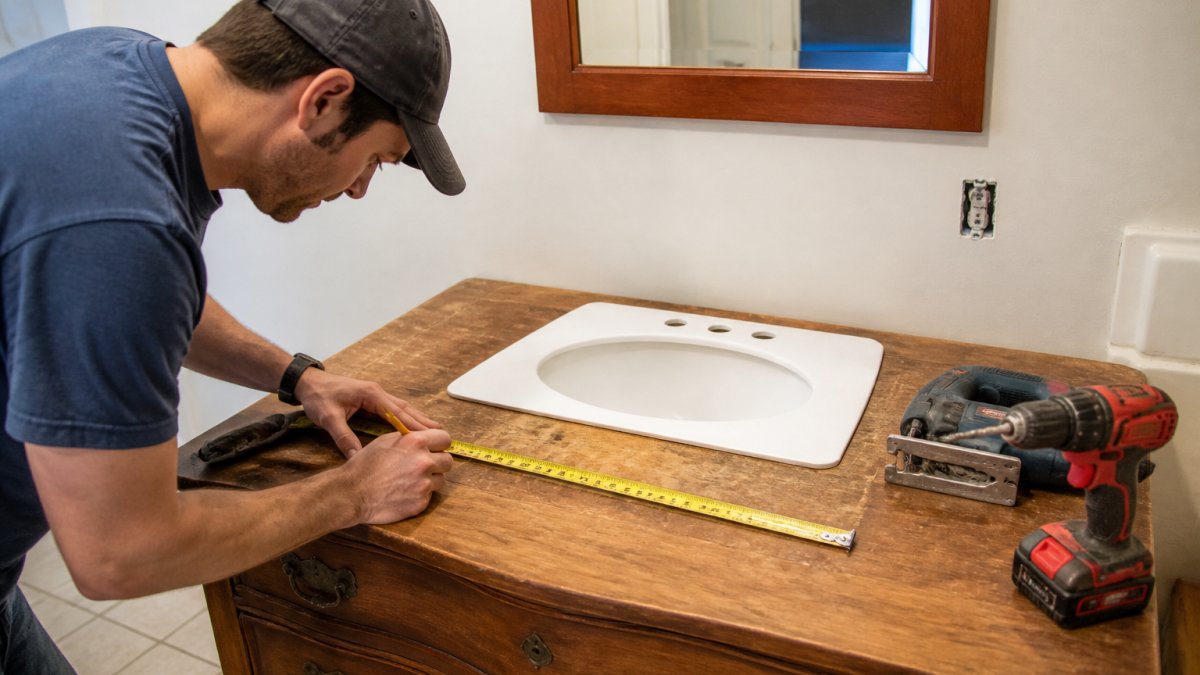 Homeowner measuring a wooden dresser to create affordable alternatives to custom bathroom vanities
Furniture conversions work best when you start with water-resistant pieces or commit to protective finishing. Dressers, nightstands, media consoles, and vintage bureaus are excellent starting points; assess plumbing compatibility and structural integrity before committing.
Dresser Bathroom Vanity Conversion: Step-by-Step
A dresser bathroom vanity conversion transforms a vintage or new dresser into functional bathroom storage with a sink. This popular DIY approach delivers substantial cost savings compared to purchasing a vanity cabinet.
Step 1: Select and Measure Your Dresser Choose a sturdy dresser with appropriate depth (18-24 inches works for most bathrooms).
Step 2: Prepare for Water Exposure Seal all exposed wood surfaces with waterproof sealant or finish, especially the top, inside surfaces, and joints where water might penetrate. Multiple coats protect better than a single application.
Step 3: Cut the Sink Opening Mark the sink cutout based on your sink's template. Use a jigsaw to cut the opening carefully. Sand edges smooth to prevent splinters and ensure the sink sits properly.
Step 4: Install the Sink and Faucet Secure the sink according to manufacturer instructions. Install the faucet through the pre-drilled holes or new holes you've created.
Step 5: Connect Plumbing Route supply lines and drain pipes through the dresser's back or bottom. Use flexible supply lines for easier installation. Connect the drain to your bathroom's existing plumbing. Test for leaks before finishing.
Step 6: Seal and Finish Apply waterproof finish to any newly exposed surfaces. Add a protective top coat to the countertop area. Install a backsplash if desired to protect the wall behind the vanity.
Other Furniture Repurposing Options
Beyond dressers, antique bureaus bring character and quality construction. Media cabinets work well when sealed properly, their shelving accommodates bathroom storage. Kitchen islands become statement vanities in larger bathrooms, and vintage nightstands suit powder rooms or guest baths.
The common thread: solid construction, appropriate dimensions, and realistic assessment of water exposure. Particle board rarely holds up to bathroom humidity; real wood or quality plywood performs better. Pieces with drawers provide valuable storage compared to open-shelf designs.
Budget-Friendly Materials: Plywood, MDF, and Reclaimed Wood
Material choice directly impacts both cost and durability of DIY or semi-custom vanities. Understanding the trade-offs helps you make decisions aligned with your budget and expectations.
Plywood offers strength and stability at moderate cost, resisting warping better than solid wood and working well for vanity cabinets when properly sealed. Water-resistant plywood costs more but protects better; paint or stain finishes work well.
MDF (Medium-Density Fiberboard) provides smooth surfaces ideal for painted finishes. It costs less than plywood or solid wood. The major limitation: MDF absorbs water readily and swells when exposed to moisture. For bathroom use, MDF requires careful sealing and isn't suitable for high-moisture areas. It works better in powder rooms with minimal water splash.
Reclaimed wood delivers character and sustainability. Salvaged barn wood, old flooring, or vintage furniture creates distinctive vanities, typically costing more than new wood but less than custom cabinetry. The trade-off is variability in grain, color, and species, which appeals to homeowners seeking unique designs.
Solid wood alternatives like oak, maple, or cherry offer durability but increase costs. Bamboo provides an eco-friendly middle ground, sustainable, affordable, and reasonably water-resistant when sealed properly.
The practical reality: durability depends on sealing and maintenance as much as the base material. Properly sealed plywood outlasts poorly maintained solid wood.
Bathroom Storage Without a Vanity: Alternative Solutions
Not every bathroom needs a traditional vanity. Alternative storage solutions work well for small spaces, unique layouts, or homeowners prioritizing open floor plans.
Wall-mounted cabinets maximize vertical space without consuming floor area. Floating shelves paired with baskets provide organized storage with visual lightness.
Medicine cabinets recessed into walls offer hidden storage without protruding into the room. Surface-mounted versions cost less but extend into the space; mirror-front models serve dual purposes, storage and reflection.
Pedestal sinks free up floor space but eliminate vanity storage entirely, suiting minimalist designs or bathrooms with storage elsewhere, especially powder rooms.
Console vanities feature slim bases with open space underneath, delivering sink functionality with visual openness ideal for small bathrooms or contemporary designs. Storage capacity is limited compared to traditional vanities.
Over-toilet storage uses vertical space above the toilet for shelving or cabinets, adding capacity without floor or wall space elsewhere. It works best with sufficient clearance above the toilet.
The decision depends on your bathroom's size, layout, and storage needs. A powder room might skip vanity storage entirely; a family bathroom needs substantial capacity. Match solutions to actual needs to avoid overcomplicating the space.
Stock vs. Semi-Custom: Finding the Middle Ground
Stock vanities represent mass-produced options available immediately. Semi-custom vanities offer customization within a manufacturer's established framework, you might choose dimensions, finishes, or hardware configurations from available options without designing entirely from scratch.
Stock vanities ship within 1-3 weeks and cost significantly less than custom options, with online retailers and big-box stores offering hundreds of styles. The limitation: if your bathroom dimensions don't match standard sizes, you adapt your space to the vanity rather than vice versa.
Semi-custom vanities bridge the gap. Manufacturers like Kraftmaid and Wellborn offer customization within their product lines: specify width in 3-inch increments, choose drawer versus door configurations, and select from available finishes. Lead times run 2-4 weeks, with costs between stock and fully custom.
The practical advantage: semi-custom solutions often cost 30-50% less than custom while delivering better fit than stock options. For most homeowners, this middle ground offers the best value. You're not paying for unlimited customization, but you're not forced into a one-size-fits-all approach either.
Evaluating semi-custom options means checking each manufacturer's customization parameters: what variables you control, lead time, and cost increase per customization. Comparing options identifies the best fit for your project.
Installation, Plumbing, and Durability Considerations
Installation complexity varies dramatically based on your vanity choice and bathroom's existing plumbing. Understanding these factors prevents surprises during your renovation.
Standard installation involves setting the vanity, connecting supply lines and drain pipes, and securing the countertop. For vanities matching your existing plumbing layout, this takes 2-4 hours and most homeowners can handle it with basic tools and plumbing knowledge.
Modified installation becomes necessary when vanity dimensions differ from the original or plumbing requires repositioning. Moving drain lines or supply connections adds complexity and cost.
Repurposed furniture installation requires the most planning. Plumbing must route through or around furniture not designed for bathroom use, and structural modifications may be needed for sink and faucet. It demands more skill than a standard vanity but remains achievable for motivated homeowners.
Durability depends on material quality and moisture management. Solid wood vanities outlast particle board when properly sealed and maintained. Vanities in high-moisture areas (near shower or tub) experience more stress than those in powder rooms.
Water damage represents the primary durability threat. Leaking faucets, loose connections, or inadequate sealing compromise vanity integrity over time. Regular inspection and prompt repair of any water issues prevents major damage. Vanities with proper drainage and sealed joints last decades.
Budget-friendly materials require more maintenance than premium options. Plywood and MDF need regular inspection for water damage. Reclaimed wood benefits from periodic resealing. The trade-off for lower upfront costs is higher maintenance demands.
How to Evaluate Ready-Made Vanity Options
Selecting a ready-made vanity from stock or semi-custom manufacturers requires assessing several factors beyond appearance.
Dimension compatibility comes first. Measure your bathroom carefully, not just the space where the vanity goes, but clearances for doors, drawers, and movement. Verify sink size matches your faucet and plumbing.
Material quality determines durability and maintenance. Examine construction, solid wood or quality plywood performs better than particle board. Check for water-resistant finishes. Ask about warranty coverage.
Plumbing compatibility matters more than many homeowners realize. Where are the drain and supply line openings? Do they match your bathroom's existing plumbing? Will you need to modify cabinet interiors to accommodate pipes?
Storage capacity should match your actual needs. Count drawers and shelves. Consider what you're storing, medications, cosmetics, cleaning supplies. Open shelving looks good but requires organization. Drawers hide clutter but limit visibility.
Finish durability affects long-term satisfaction. Painted finishes look fresh but chip with use. Stained finishes show water spots. Laminate finishes resist damage but can't be refinished if damaged.
Price transparency prevents budget surprises. Get total cost including delivery and installation. Some retailers quote vanity price only, adding delivery and assembly fees later.
Return policies matter if the vanity doesn't work in your space. Some retailers accept returns; others don't. Confirm the policy before purchasing, especially for online orders where you can't see the product in person.
Affordable alternatives to custom bathroom vanities range from prefab stock options to creative furniture repurposing. Call 434-944-4649 to discuss your project with our team.
Frequently Asked Questions
What is the cheapest alternative to a custom bathroom vanity?
Stock vanities from home improvement retailers offer the lowest upfront cost, typically ranging from budget-friendly options to mid-range choices. Repurposing existing furniture, dressers, media cabinets, or vintage bureaus, can be even cheaper if you already own the piece. DIY conversions with plywood or MDF also cost less than custom-built vanities. The total depends on materials, sink installation, and plumbing modifications needed.
Are prefab bathroom vanities cheaper than custom vanities?
Yes, prefab vanities are significantly cheaper than fully custom options. Stock vanities come ready-made in standard sizes and finishes, eliminating design and fabrication costs. Custom vanities require measurements, material selection, handcrafted construction, and installation, adding substantial expense. Prefab options sacrifice personalization but deliver affordability and faster installation, making them ideal for budget-conscious renovations.
Can a dresser be converted into a bathroom vanity?
Absolutely. A dresser bathroom vanity conversion is a popular DIY project. You'll need to cut a hole in the top for the sink, seal the wood against moisture exposure, install plumbing connections, and ensure water resistance with appropriate finishes. Solid wood dressers work better than particleboard, and you must account for plumbing access and countertop material. Many homeowners successfully create nontraditional, personalized vanities this way.
What can I use instead of a bathroom vanity cabinet?
Beyond traditional vanity cabinets, consider wall-mounted shelving, open shelving with baskets, pedestal sinks with storage solutions, medicine cabinets for medicines and small items, or floating shelves paired with under-sink storage. These alternatives work well for minimalist interiors, small bathrooms, or renters. Reclaimed wood shelves add character while providing functional storage. The best choice depends on your space, plumbing layout, and how much storage capacity you need.
Frequently asked questions
What is the cheapest alternative to a custom bathroom vanity?
Stock vanities from home improvement retailers offer the lowest upfront cost, typically ranging from budget-friendly options to mid-range choices. Repurposing existing furniture—dressers, media cabinets, or vintage bureaus—can be even cheaper if you already own the piece. DIY conversions with plywood or MDF also cost less than custom-built vanities. The total depends on materials, sink installation, and plumbing modifications needed.
Are prefab bathroom vanities cheaper than custom vanities?
Yes, prefab vanities are significantly cheaper than fully custom options. Stock vanities come ready-made in standard sizes and finishes, eliminating design and fabrication costs. Custom vanities require measurements, material selection, handcrafted construction, and installation—adding substantial expense. Prefab options sacrifice personalization but deliver affordability and faster installation, making them ideal for budget-conscious renovations.
Can a dresser be converted into a bathroom vanity?
Absolutely. A dresser bathroom vanity conversion is a popular DIY project. You'll need to cut a hole in the top for the sink, seal the wood against moisture exposure, install plumbing connections, and ensure water resistance with appropriate finishes. Solid wood dressers work better than particleboard, and you must account for plumbing access and countertop material. Many homeowners successfully create nontraditional, personalized vanities this way.
What can I use instead of a bathroom vanity cabinet?
Beyond traditional vanity cabinets, consider wall-mounted shelving, open shelving with baskets, pedestal sinks with storage solutions, medicine cabinets for medicines and small items, or floating shelves paired with under-sink storage. These alternatives work well for minimalist interiors, small bathrooms, or renters. Reclaimed wood shelves add character while providing functional storage. The best choice depends on your space, plumbing layout, and how much storage capacity you need.